Producer payouts ·
How to Resolve Insurance Producer Commission Disputes with Clear Records
By SplitVerde editorial team · Insurance agency operations
Resolve producer commission disputes using carrier evidence, split agreements, adjustments, and payment records. This guide focuses on the evidence and practical steps needed to make the result trustworthy.
Pin down the disputed line
Ask for the policy or account reference, statement period, expected amount, and disputed calculation. Locate the original carrier row and any later reversal. Determine whether the carrier commission was actually reported or remains expected. Start with one transaction rather than debating the entire month's payout. This keeps the conversation grounded in evidence rather than frustration.
Before treating a number as final, ask which source supports it and what period the source covers. A policy effective date, a carrier statement date, and a bank deposit date can all be different. Keep those distinctions explicit. If a carrier changes a schedule or revises a statement, retain the prior evidence and record the reason for the new interpretation. A reviewer should be able to reproduce the conclusion without relying on someone's memory or a screenshot of a summary total. This discipline matters most when an apparent discrepancy crosses month-end or affects producer compensation.
Check the agreement version
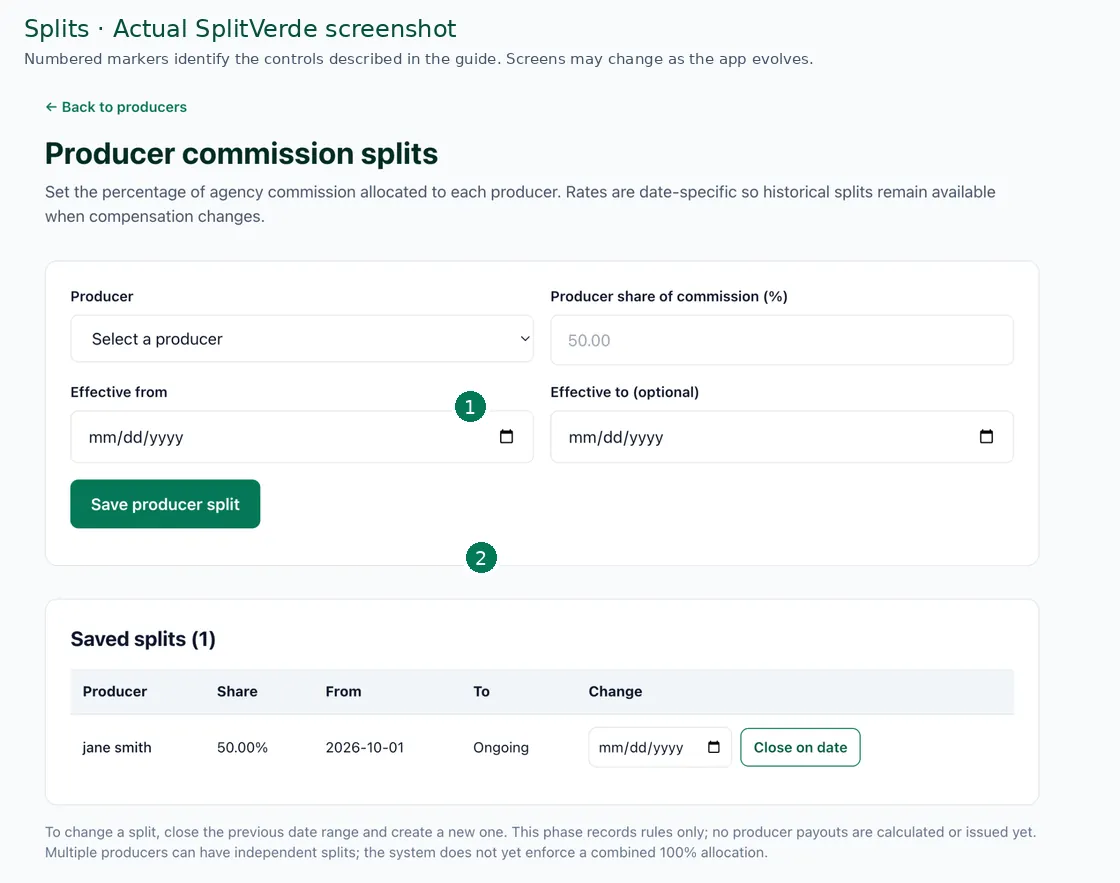
Identify the producer agreement and effective date governing the transaction. New-business and renewal splits may differ; shared accounts can use special allocations. Confirm the commission basis before applying the percentage. A current default split rate should not silently recalculate a previously approved transaction. If the terms are ambiguous, seek appropriate professional guidance instead of inventing a rule.
Be careful with the difference between missing information and a confirmed error. A blank field, absent statement, or uncertain matching key does not prove the carrier underpaid. It means the record needs investigation. Mark that status clearly, assign ownership, and keep a next review date. This protects the agency from wasting time on false alarms while ensuring real shortages remain visible. When asking a carrier for help, provide the policy reference, relevant period, expected amount, and the evidence behind the question.
Explain chargebacks separately
Preserve the original positive carrier commission and any later negative adjustment as separate events. Link them by policy and source statement. A carrier reversal does not automatically authorize an agency to deduct from producer compensation; the agreement and applicable law matter. Explain the original event, reason for adjustment, and how any approved change affects the producer statement.
An accurate reconciliation can still be incomplete if the input is wrong. Validate imported transaction counts and signed totals against the original statement. Inspect a sample of negative adjustments and identifiers with leading zeros. A matching grand total can hide two offsetting policy errors, and a successful upload does not guarantee correct extraction. Stop when a source validation fails; otherwise the matching engine may produce dozens of convincing but meaningless exceptions. Preserve the failed import and the reason for correction.
| Policy | Expected | Reported | Difference |
|---|---|---|---|
| A | $200 | $250 | +$50 |
| B | $200 | $150 | −$50 |
| Total | $400 | $400 | Two exceptions |
Illustrative amounts, not actual carrier transactions.
Example: two different split bases
A carrier reports $500 in commission and the producer agreement specifies 40% of eligible agency commission. If the entire $500 qualifies, the calculated share is $200. Subtracting an unrelated $50 adjustment first would produce $180, but that basis is not automatically valid. Determine which transaction the adjustment belongs to and what the agreement permits before approving the calculation.
Build the workflow around distinct transaction states. Expected is not the same as reported; reported is not the same as deposited; a calculated producer share is not the same as an approved or transferred payout. These categories may be related, but merging them hides the cause of a delay. A useful dashboard shows where the transaction sits and which evidence is missing. That makes it possible to answer a producer's question without claiming money was received before it reached the agency.
Separate approved from paid
A correct calculation may still be awaiting manager approval, and an approved payout may not yet have been transferred. Record calculated, reviewed, approved, and paid statuses separately. Verify actual transfers through the payment system. Share only the client information necessary to explain the disputed transaction. A producer needs a clear calculation, not unrestricted access to the agency's entire book.
Negative amounts deserve the same attention as positive commissions. A chargeback may reflect cancellation, premium change, rewrite, or correction. Keep the original payment and the negative event separately with their own statement dates. Do not overwrite the original with the net result. Whether the negative event affects a producer payout depends on the governing agreement and applicable law. Record the investigation and approval rather than letting a spreadsheet formula silently decide compensation.
Resolve with a traceable correction
Record the outcome, supporting carrier evidence, applicable split rule, reviewer, and payout status. Preserve the original statement and issue a clearly identified adjustment rather than silently overwriting history. If the carrier promised a future correction, leave that portion open until the later statement confirms it. Track recurring causes such as outdated producer assignments and unclear chargeback terms.
At the end of the period, retain the original statement, matching results, unresolved exceptions, carrier correspondence, and review decisions. Keep open items assigned to a person and a follow-up date. A promised correction is not verified until a later statement contains the relevant transaction. Bank-deposit matching should be performed separately from policy-level commission review. The objective is not to make every cell green; it is to create a reliable explanation for the money the agency expected, the carrier reported, and the agency actually received.
Frequently asked questions
Does a matching statement total mean every policy is correct?
No. Offsetting policy-level errors can produce the same grand total. Check each relevant transaction.
Should unresolved matches be automatically approved?
No. Keep uncertain matches visible until sufficient supporting evidence establishes the correct transaction.
Does a negative carrier commission automatically reduce producer pay?
Not necessarily. Review the applicable producer agreement and law before making compensation adjustments.
Related guides
Read our reconciliation overview, file format comparison, and monthly checklist.