Reconciliation ·
Monthly Insurance Agency Commission Reconciliation Checklist
By SplitVerde editorial team · Insurance agency operations
A good month-end routine should be boring. That's the point: fewer surprises, fewer lost payments, and no detective work at tax time.
The takeaway
Keep the original carrier data, document what you expect, and investigate differences at the transaction level before approving payouts or closing the month.
Step 1: Confirm the source files arrived
List the carriers that should have produced statements for the period. Confirm every expected file is present, note the reporting dates, and save the original downloads. If a statement is missing, flag the entire carrier period rather than treating its absent transactions as individual underpayments. Record file names and download dates so the next reviewer can identify exactly which source was used.
Step 2: Validate the imports
Check row counts, signed totals, and obvious formatting problems before matching. Watch for missing policy numbers, dates interpreted in the wrong format, and negative amounts accidentally converted to positive. Text PDFs and spreadsheet exports can represent transactions differently. A successful upload is not proof of a complete import. Keep the original file for comparison when a row looks suspicious.
Step 3: Update expected commissions
Refresh expected amounts for issued policies, renewals, endorsements, cancellations, and rate changes. Tie the expectations to the applicable commission schedules and policy status. If an expectation is uncertain, label it for review instead of forcing a match. The quality of the expected ledger determines the usefulness of every variance report that follows.
| Transaction | Expected | Reported | Next step |
|---|---|---|---|
| Policy A · renewal | $240 | $240 | Matched |
| Policy B · new | $180 | $120 | Check $60 variance |
| Policy C · adjustment | Review | −$75 | Trace original |
Step 4: Match transactions and review differences
Compare by carrier, policy, transaction type, statement period, and amount. Separate clean matches from partial payments, missing records, unexpected positives, chargebacks, and possible duplicates. A matching grand total does not mean every policy is correct. Two offsetting errors can hide inside the same statement. Review at least a sample of matched records as a quality control.
Step 5: Investigate and assign exceptions
For each unresolved difference, record the expected amount, reported amount, variance, evidence, owner, and next action. Prioritize material and aging items. Contact the carrier with specific policy and statement references when necessary. Carry unresolved cases into the next month. Do not mark an issue resolved just because a carrier representative says a correction is coming.
Step 6: Review producer calculations
Only after agency commissions are reconciled should you apply producer split rules. Confirm assignments, new-business versus renewal rates, shared-credit arrangements, and treatment of negative adjustments. Document approval separately from the calculation. Producer compensation obligations depend on agreements and applicable law, so ambiguous cases need review rather than automated assumptions.
Step 7: Tie out cash and close the period
Compare the carrier's remittance to bank deposits, accounting for documented timing differences and offsets. Archive statement files, exception reports, and approved payout records. Record who completed the review and what remains open. A closed month should mean that unexplained differences are visible and owned—not that every number was forcibly made to match.
A balanced total can hide two wrong payments
Imagine an agency expects $200 on Policy A and $200 on Policy B. The carrier reports $250 for A and $150 for B. Both totals equal $400, but each policy has a $50 discrepancy in opposite directions. A summary-only check calls the month balanced while missing both exceptions. That is why the checklist must compare individual transactions before it verifies totals. The same problem happens when an unexpected commission offsets a chargeback. Review matching by carrier, policy, transaction type, period, and amount. Keep uncertain matches visible for human review. A high match rate is not proof that all meaningful differences have been resolved. One large underpayment can matter more than dozens of small timing exceptions. If the original import missed rows, even a detailed comparison can be misleading. Validate source counts and signed totals before trusting the result.
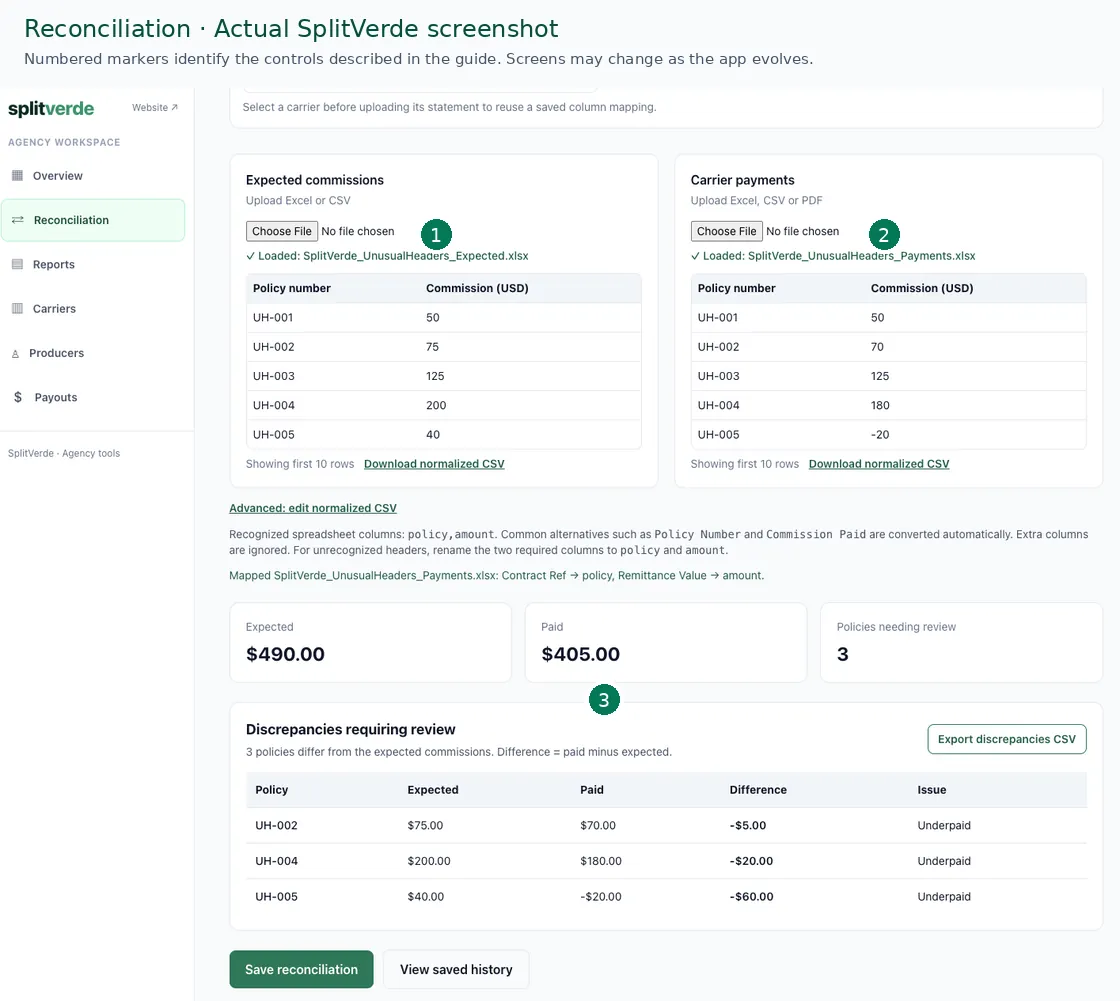
What a completed monthly review should contain
Keep original carrier statements, expected commission records, import validation results, matched and unmatched transaction reports, an exception log, carrier responses, and any producer payout approvals. Assign owners and follow-up dates to unresolved differences. A reporting period can close with open exceptions if they are clearly tracked; it should not close by quietly changing expected values until the numbers match. Reconcile bank deposits separately from carrier statement transactions. For agency owners, summarize the dollar value of open exceptions, the oldest unresolved case, the largest adjustment, missing statements, and payouts awaiting approval. This is more useful than a single green status indicator. Record who reviewed each checkpoint. Even in a small agency where one person does most of the work, a repeatable record prevents the next month from becoming a reconstruction exercise. The goal is not extra paperwork; it is a reliable answer to where the money went.
Frequently asked questions
How often should an agency reconcile commissions?
Monthly is a practical baseline, aligned to carrier statement cycles; high-volume agencies may review more frequently.
What should I do with unresolved discrepancies?
Assign an owner and follow-up date, preserve evidence, and carry them forward until verified.
Does commission reconciliation replace bank reconciliation?
No. Transaction matching and cash reconciliation are related but separate checks.
Keep learning
Explore our insurance commission reconciliation guide, statement reconciliation walkthrough, and producer payouts guide.