Producer payouts ·
Producer Commission Split Changes: Effective Dates and Retroactive Adjustments
By SplitVerde editorial team · Insurance agency operations
A producer's commission percentage can change while policies continue to renew. Without an effective-dated record, the agency may calculate the right percentage against the wrong transaction period.
Treat split agreements as versioned rules
Store the signed producer agreement and every approved amendment with its effective date. Different rules may apply to new business, renewals, shared accounts, or specific carriers. A current split percentage is not enough to recalculate an older statement. Preserve prior versions rather than overwriting them. The agency should be able to explain which rule was active for a particular transaction and why. When language is ambiguous, seek clarification before approving payouts rather than guessing from a spreadsheet.
Decide which date governs a transaction
A policy may be effective in June, appear on a July carrier statement, and reach the agency bank account in August. Which date determines the producer split depends on the governing agreement. Do not assume the carrier statement date is always controlling. Record the relevant dates and the agreement's definition of when commission is earned or payable. A documented rule avoids applying a new split to older business simply because the payment arrived after an amendment.
Example: an approved split increase
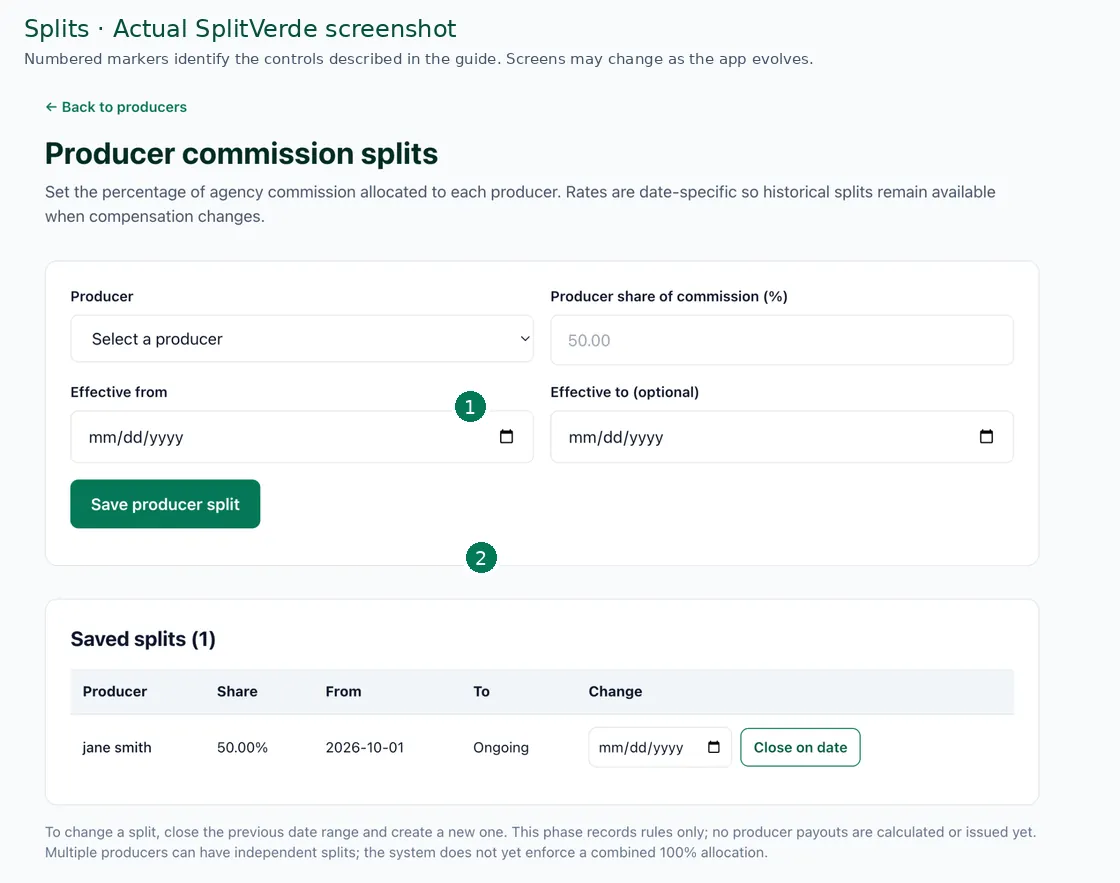
Suppose a producer's approved split changes from 40% to 45% on July 1. A $200 commission transaction governed by the old agreement would produce an illustrative $80 share; a comparable transaction governed by the new agreement would produce $90. The difference is $10 per transaction, but the critical question is which agreement version applies. A payment received in July may still relate to an earlier eligible transaction. This example assumes the same commission basis and no other adjustments.
Handle retroactive changes explicitly
Sometimes the agency and producer agree that a new split applies to earlier transactions. Record the authorized retroactive start date, affected policies or periods, approving parties, and recalculated amounts. Do not silently modify old payout history. Create adjustment entries that reference the original calculations, preserving both the prior payment and the new correction. Confirm that retroactive changes comply with the agreement and applicable law. This is especially important when negative adjustments or repayment requests are involved.
Prevent duplicate producer credits
When several producers share an account, ensure their assigned percentages and eligibility are applied to the correct commission basis. A transfer of account ownership can create overlapping claims if the old and new assignments are both active. Review effective dates and approvals before distributing the same transaction twice. Flag situations where split rules conflict or where total assigned shares exceed the agency's intended allocation. Preserve any manual overrides with an explanation and approver.
Separate calculation, approval, and payment
A producer payout report is a calculation, not proof of a bank transfer. Keep calculated share, reviewed amount, approved amount, payout batch, and actual payment status distinct. If a later carrier chargeback affects the transaction, review the agreement before applying a producer deduction. A negative carrier row does not automatically grant a recovery right. Transparent statements should show the original policy, carrier transaction, governing split version, and any adjustment.
Audit split changes each month
Review newly effective agreements before processing the next carrier statements. Sample transactions near the effective-date boundary, where errors are common. Compare producer assignments with approved documents and investigate overrides. Archive the source commission, split calculation, approvals, and payout evidence. This monthly control is cheaper than reconstructing a year's worth of producer compensation after someone notices that an outdated rate was applied.
Boundary-date testing before payouts
Most effective-date errors happen near the moment a new agreement takes effect. Build a small sample that includes transactions immediately before, on, and after the boundary. For each, record the policy transaction date, statement period, applicable contract rule, commission basis, and resulting split. Have a reviewer compare the calculation with the signed amendment rather than relying only on the current producer profile. This is especially useful when commission statements arrive weeks after the underlying policy activity.
A second risk is the use of different dates for different commission types. An agreement might define a new-business split by one event and renewal compensation by another. Do not apply one universal date rule unless the agreement supports it. If the document does not explain how to handle a correction issued after the effective date, resolve that ambiguity before the payout is approved. Documenting the interpretation once can prevent repeated disputes.
When correcting an old calculation, produce a readable adjustment statement. It should show the original commission transaction, original split, revised authorized split, difference, approval, and whether money actually changed hands. Keep the original payout intact in the audit trail. A producer who sees only a negative adjustment without context may reasonably question it. Transparent effective-date records protect both parties from avoidable confusion.
Practical checklist
- Keep the original carrier evidence and verify imported row counts and signed totals.
- Record the rule and timing basis for every expected amount.
- Separate policy-level differences from statement-to-bank differences.
- Assign unresolved issues to an owner and set a follow-up date.
- Preserve corrections as new events rather than replacing prior records.
Frequently asked questions
Does a matching bank deposit prove every policy commission is correct?
No. A deposit can match the carrier's remittance even when individual policy transactions contain errors. Reconcile policy-level accuracy separately.
Should an agency delete an incorrect transaction after a correction?
No. Keep the original entry and the correction linked so the timing and explanation remain auditable.
Can a negative carrier commission automatically reduce producer pay?
Not necessarily. Review the producer agreement and applicable law before changing producer compensation.
Related guides
Explore the monthly reconciliation checklist, commission KPIs, and producer splits and payouts.
The 7-day trial requires a payment card and renews unless canceled. SplitVerde does not offer direct carrier integrations or scanned-image PDF OCR.