Reconciliation ·
Year-End Insurance Commission Reconciliation: Audit Checklist for Agencies
By SplitVerde editorial team · Insurance agency operations
A year-end commission review should answer more than whether the deposits matched the bank. It should show which policies generated commission, what the carrier reported, what remained disputed, and how producer payments were approved.
Set the scope of the year-end review
List carriers, agency codes, statement periods, and compensation programs included in the review. Identify missing monthly statements and any acquired or transferred books. Decide which items belong in ordinary policy commissions and which belong in supplemental compensation. Preserve original source files before making adjustments. An audit that starts from only the bank total cannot show whether individual policies were underpaid or whether negative transactions were correct.
Reconcile the annual transaction population
Aggregate the monthly carrier rows without discarding transaction identifiers, policy references, dates, or signs. Include new business, renewals, endorsements, installments, cancellations, chargebacks, and corrections. Confirm that the imported annual row count and signed totals agree with the archived monthly statements. Look for duplicated imports and gaps between statement periods. A complete population is the foundation for every later exception calculation.
Review open and aging exceptions
Carry forward unresolved policy-level discrepancies with original source references, expected amounts, carrier-reported amounts, status, owner, and next follow-up date. Group cases by carrier and age to find recurring problems. Separate confirmed shortages from not-yet-due expectations, ambiguous matches, and unexpected overpayments. Do not erase a discrepancy merely because the annual total balances after offsetting errors. A year-end report should disclose uncertainty rather than hiding it.
Tie remittances to deposits separately
For each carrier, compare the statement remittance totals with actual deposits, allowing for documented timing differences and netted adjustments. A December statement may deposit in January, so label cutoff differences clearly. The cash reconciliation does not prove that the carrier calculated every policy commission correctly. Keep both controls: policy-level expectation versus statement, and statement remittance versus bank. If the carrier nets an earlier chargeback into a later payment, preserve the linkage.
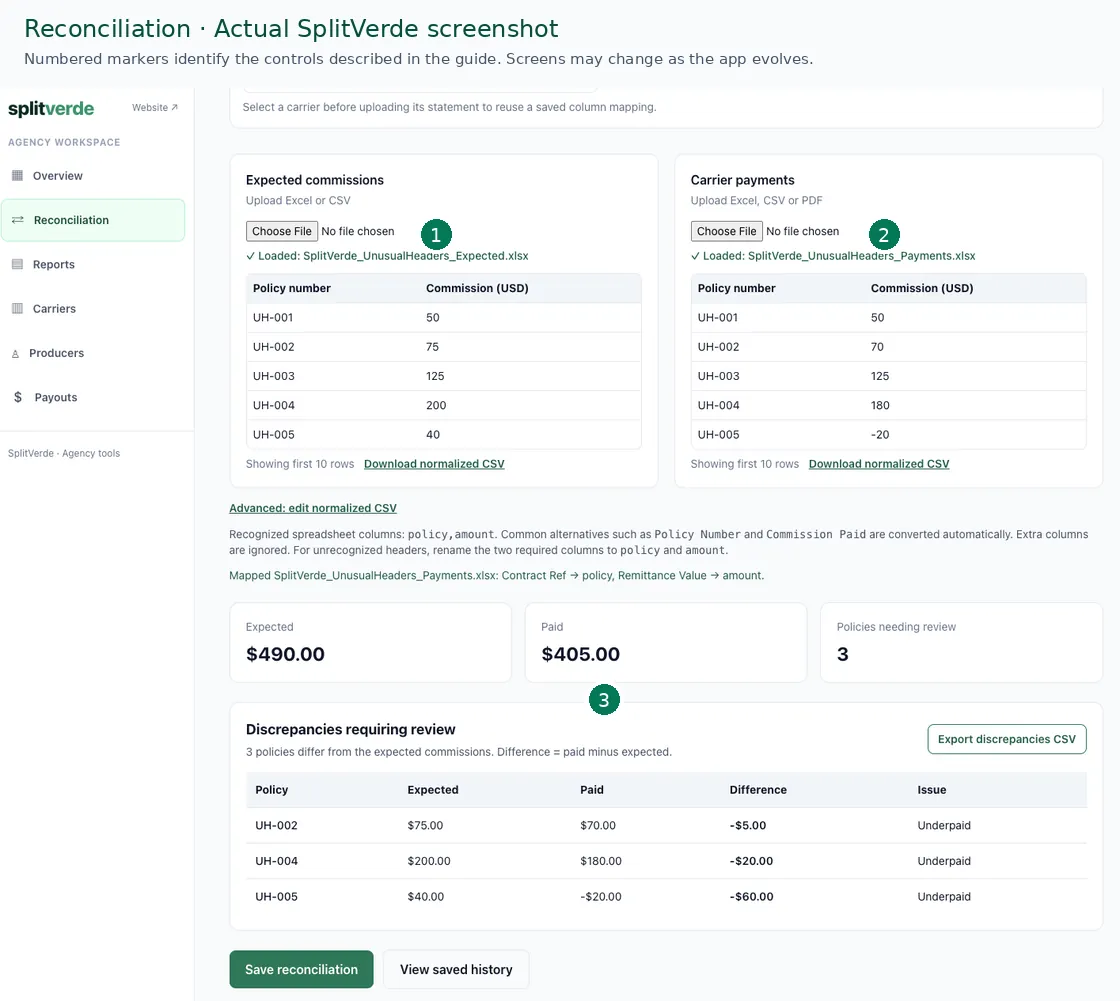
Audit producer calculations and approvals
Select samples across producers, carriers, and effective-date boundaries. Verify that the correct agreement version and split rate were applied to the appropriate commission basis. Distinguish calculated, approved, and actually paid amounts. Review manual overrides and chargeback deductions for authorization under the governing agreement and applicable law. Retain payout statements and transfer evidence. A payout batch export alone is not proof that a producer received funds.
Build an evidence package another reviewer can follow
Archive carrier statements, import validation summaries, matching reports, exception logs, carrier correspondence, producer agreements, approval records, and deposit comparisons. Name files consistently by carrier and period. Link later corrections to their original transactions instead of overwriting history. Include a concise summary of material unresolved amounts and the next action for each. The test is whether someone unfamiliar with the agency can reconstruct a sampled commission without guessing.
Turn findings into next year's controls
Identify the carriers responsible for repeated missing rows, unusual reversals, or import problems. Document whether the root cause was carrier timing, agreement interpretation, policy-number mapping, or internal process. Update monthly checklists and owner assignments accordingly. A year-end audit is most valuable when it reduces the next year's reconciliation effort, not when it simply produces another spreadsheet that no one revisits.
Sample testing and cutoff examples
A useful year-end review samples different transaction types rather than selecting only the largest positive commissions. Include a renewal, new business, endorsement, negative chargeback, correction, and at least one transaction near the year-end boundary. For each sample, trace the policy or transaction evidence to the carrier statement, then to the remittance and bank record. If producer compensation applies, verify the agreement version and actual payout status separately.
Consider a carrier statement dated December 31 with a deposit received January 3. The statement belongs to one reporting period and the cash movement to another. That timing difference does not necessarily mean the carrier underpaid. Record the relevant dates and apply the agency's accounting policies consistently. Conversely, a deposit that matches the December statement total still does not prove each policy's commission rate was correct. These are two different tests, and both should be visible in the close package.
Before filing the year-end package, ask a reviewer to reconstruct one unresolved discrepancy without relying on the preparer's memory. Can they find the original statement row, expected calculation, carrier correspondence, assigned owner, and next action? If any link is missing, improve the references. Repeat the exercise for a resolved correction to ensure that the original transaction has not been overwritten. The purpose of year-end review is an evidence trail that remains understandable after staff or systems change.
Practical checklist
- Keep the original carrier evidence and verify imported row counts and signed totals.
- Record the rule and timing basis for every expected amount.
- Separate policy-level differences from statement-to-bank differences.
- Assign unresolved issues to an owner and set a follow-up date.
- Preserve corrections as new events rather than replacing prior records.
Frequently asked questions
Does a matching bank deposit prove every policy commission is correct?
No. A deposit can match the carrier's remittance even when individual policy transactions contain errors. Reconcile policy-level accuracy separately.
Should an agency delete an incorrect transaction after a correction?
No. Keep the original entry and the correction linked so the timing and explanation remain auditable.
Can a negative carrier commission automatically reduce producer pay?
Not necessarily. Review the producer agreement and applicable law before changing producer compensation.
Related guides
Explore the monthly reconciliation checklist, commission KPIs, and producer splits and payouts.
The 7-day trial requires a payment card and renews unless canceled. SplitVerde does not offer direct carrier integrations or scanned-image PDF OCR.