Reconciliation ·
How to Reconcile Insurance Commissions Across Multiple Carriers
By SplitVerde editorial team · Insurance agency operations
Reconcile multiple carriers using consistent imports and carrier-specific commission schedules. This guide focuses on the evidence and practical steps needed to make the result trustworthy.
Create one intake calendar
Track each carrier, relevant line of business, statement cycle, portal, expected period, and assigned reviewer. A missing carrier statement is not the same as a missing policy payment. Mark incomplete periods before running agency-wide metrics. Otherwise a carrier that has not supplied its file can make the match rate appear artificially high or create hundreds of premature shortage alerts.
Before treating a number as final, ask which source supports it and what period the source covers. A policy effective date, a carrier statement date, and a bank deposit date can all be different. Keep those distinctions explicit. If a carrier changes a schedule or revises a statement, retain the prior evidence and record the reason for the new interpretation. A reviewer should be able to reproduce the conclusion without relying on someone's memory or a screenshot of a summary total. This discipline matters most when an apparent discrepancy crosses month-end or affects producer compensation.
Standardize fields, not compensation rules
Use common fields for carrier, policy, transaction type, period, and signed amount. Keep carrier-specific header mappings, date formats, commission schedules, and payment triggers. A field called Net Commission may mean different things across carriers. Validate imported row counts and signed totals against each original statement. A single universal mapping without testing is an efficient way to generate wrong answers.
Be careful with the difference between missing information and a confirmed error. A blank field, absent statement, or uncertain matching key does not prove the carrier underpaid. It means the record needs investigation. Mark that status clearly, assign ownership, and keep a next review date. This protects the agency from wasting time on false alarms while ensuring real shortages remain visible. When asking a carrier for help, provide the policy reference, relevant period, expected amount, and the evidence behind the question.
Keep carrier in the matching key
The same policy number can appear in different carrier systems. Include carrier identity and transaction context when comparing records. Distinguish new business, renewals, endorsements, reversals, and corrections. An amount match is not enough. If a policy moves between carriers, keep an evidence-backed cross-reference rather than automatically merging unrelated transactions.
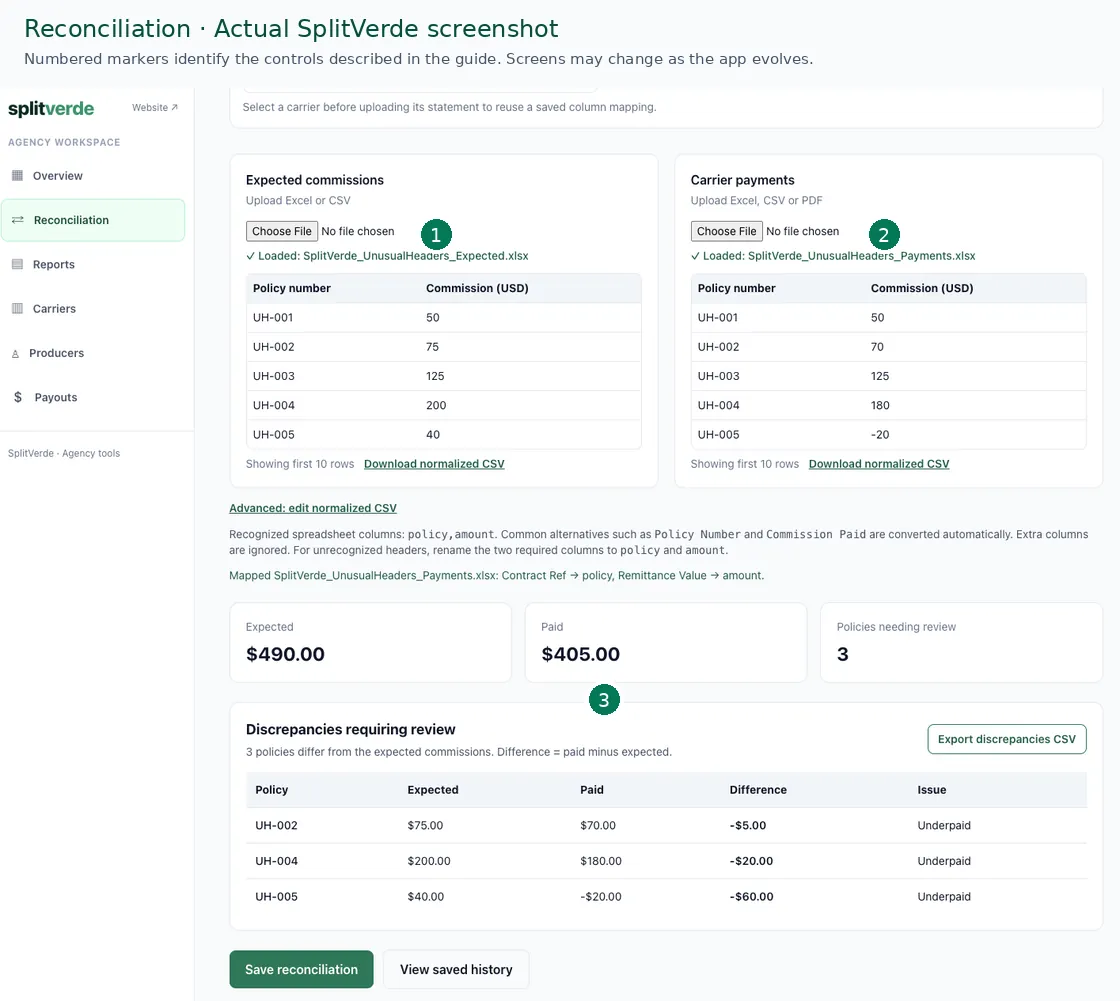
An accurate reconciliation can still be incomplete if the input is wrong. Validate imported transaction counts and signed totals against the original statement. Inspect a sample of negative adjustments and identifiers with leading zeros. A matching grand total can hide two offsetting policy errors, and a successful upload does not guarantee correct extraction. Stop when a source validation fails; otherwise the matching engine may produce dozens of convincing but meaningless exceptions. Preserve the failed import and the reason for correction.
| Policy | Expected | Reported | Difference |
|---|---|---|---|
| A | $200 | $250 | +$50 |
| B | $200 | $150 | −$50 |
| Total | $400 | $400 | Two exceptions |
Illustrative amounts, not actual carrier transactions.
Separate timing from shortages
Carrier payment eligibility, statement cutoffs, and remittance cycles vary. Record the applicable schedule version with each expectation. Classify not-yet-due items separately from confirmed missing commissions. When comparing carrier performance, do not count uncertain timing questions as proven underpayments. Prioritize material confirmed differences and older unresolved exceptions.
Build the workflow around distinct transaction states. Expected is not the same as reported; reported is not the same as deposited; a calculated producer share is not the same as an approved or transferred payout. These categories may be related, but merging them hides the cause of a delay. A useful dashboard shows where the transaction sits and which evidence is missing. That makes it possible to answer a producer's question without claiming money was received before it reached the agency.
Example: same amount, different event
Carrier A reports a $150 renewal. Carrier B reports a $150 positive correction to a previously canceled policy. The rows have the same signed amount but different policy histories and possibly different producer implications. A matcher using amount alone could incorrectly treat them as equivalent. Preserve carrier, policy reference, transaction type, and statement period. Review the underlying events before using the totals for payout calculations.
Negative amounts deserve the same attention as positive commissions. A chargeback may reflect cancellation, premium change, rewrite, or correction. Keep the original payment and the negative event separately with their own statement dates. Do not overwrite the original with the net result. Whether the negative event affects a producer payout depends on the governing agreement and applicable law. Record the investigation and approval rather than letting a spreadsheet formula silently decide compensation.
Roll up without netting away problems
Report statement coverage, unmatched dollar value, exception age, negative adjustments, and import validation issues by carrier. Then provide an agency-wide summary with consistent definitions. Do not offset one carrier's shortage with another carrier's unexpected positive commission. Assign an owner and follow-up date to every material case. The goal is one repeatable workflow that respects genuine differences among carriers.
At the end of the period, retain the original statement, matching results, unresolved exceptions, carrier correspondence, and review decisions. Keep open items assigned to a person and a follow-up date. A promised correction is not verified until a later statement contains the relevant transaction. Bank-deposit matching should be performed separately from policy-level commission review. The objective is not to make every cell green; it is to create a reliable explanation for the money the agency expected, the carrier reported, and the agency actually received.
Frequently asked questions
Does a matching statement total mean every policy is correct?
No. Offsetting policy-level errors can produce the same grand total. Check each relevant transaction.
Should unresolved matches be automatically approved?
No. Keep uncertain matches visible until sufficient supporting evidence establishes the correct transaction.
Does a negative carrier commission automatically reduce producer pay?
Not necessarily. Review the applicable producer agreement and law before making compensation adjustments.
Related guides
Read our reconciliation overview, file format comparison, and monthly checklist.