Commission operations ·
How to Implement Insurance Commission Reconciliation Software: A Step-by-Step Checklist
By SplitVerde editorial team · Insurance agency operations
Switching from spreadsheets to reconciliation software is not mainly a data-upload project. The real work is defining what the agency expects, validating the source files, and deciding how discrepancies will be resolved.
Choose a pilot carrier and a manageable period
Start with one carrier whose commission statement is available and whose compensation schedule you understand. Select a recent statement period with enough new business, renewals, and adjustments to test the workflow. Avoid beginning with every carrier and several years of history. A small pilot lets you find import and matching problems without creating hundreds of false exceptions. Preserve the original statement and a snapshot of the agency's expected policy population before importing anything.
Inventory the files and fields
List the carrier statement formats you receive and the agency records used to calculate expected commission. Identify policy number, insured, carrier, transaction type, effective or statement date, expected amount, and reported amount. Treat policy numbers as text, especially when they contain leading zeros. Note carrier-specific date conventions and negative amount representations. For text-based PDFs, check extraction quality against the visible statement. Do not assume scanned-image OCR or direct carrier integrations are available in SplitVerde.
Validate imports before interpreting results
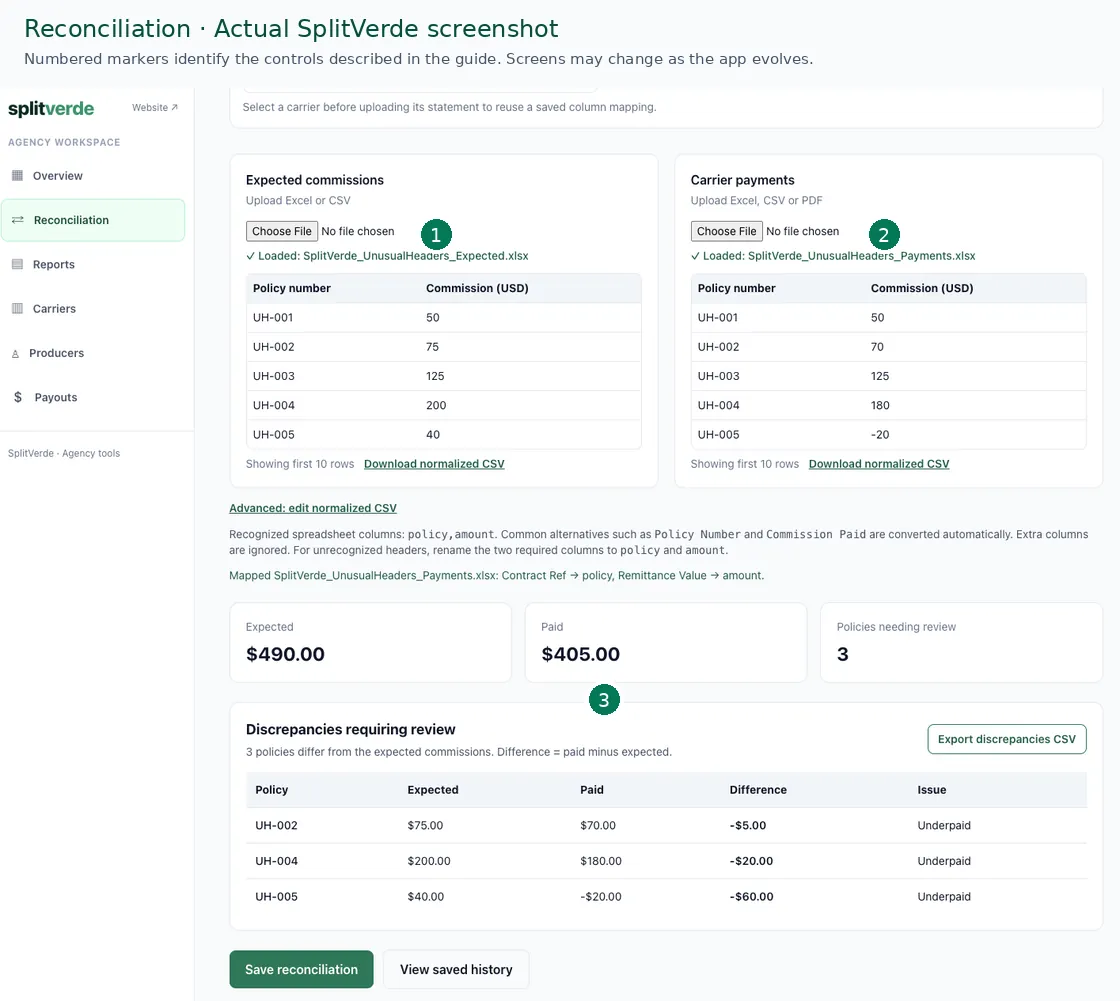
After uploading a file, compare imported row counts and signed totals with the original carrier statement. Check a sample of policy references, dates, positive payments, and negative adjustments. A clean-looking results table can still be wrong if the importer dropped rows or converted identifiers. If validation fails, fix the mapping and reimport instead of editing expectations to force a match. Keep a record of the format rule that solved the issue so the next month's statement can use the same process.
Test matching with known transactions
Choose a small set of policies whose commission amounts you can verify manually. Include at least one correct match, one underpayment candidate, one overpayment candidate, one endorsement or reversal, and one unmatched policy. Compare the software's results with the source evidence. A $200 expected payment reported as $250 is a variance, not a match merely because the policy number aligns. Conversely, a different transaction code or payment cycle may explain a difference without indicating carrier error. Document the outcome for each test case.
Create an exception ownership workflow
Define who investigates missing payments, ambiguous matches, negative adjustments, and carrier disputes. Give each exception a source reference, suspected cause, owner, status, and follow-up date. Decide when a case can be closed: a documented explanation or a verified correction should support the outcome. A carrier promise to fix something next month is not yet a recovered payment. Keep source statements and correspondence accessible so another reviewer can reconstruct the case.
Add producer splits only after the carrier layer is reliable
If the agency uses producer compensation features, configure the signed agreements and effective-dated split rules carefully. Test new-business, renewal, shared-account, and adjustment cases. Separate calculated producer shares, approved payouts, and actual payment execution. SplitVerde can help organize split and payout calculations, but it does not automatically run payroll. A carrier chargeback does not by itself authorize a producer deduction; review the agreement and applicable law before approving changes.
Run a parallel close and measure results
For the first pilot month, compare the new software results with the agency's existing reconciliation method. Investigate differences instead of assuming either source is automatically correct. Measure source coverage, policy-level matches, unresolved exceptions, and time spent on review. Reconcile carrier remittances to bank deposits separately. Once the pilot is reliable, add carriers one at a time with documented import rules. The objective is a repeatable process, not a rushed migration that hides old errors in a new interface.
Extra implementation notes
Plan the first rollout around a concrete definition of success. For example, the agency may want every received carrier statement validated, all material policy variances assigned for review, and no producer payout approved without an identifiable agreement basis. These are process outcomes that can be checked. Avoid measuring success only by how many files were uploaded or how quickly the dashboard appeared. A fast import that silently loses negative transactions is not a successful implementation.
Document each carrier's preferred file format, policy-number normalization rule, date convention, and signed amount mapping. When the carrier changes its export, compare the new file with the last verified example before trusting the import. Keep source data immutable and link corrections to their original transactions. This practice matters as much as software choice because reconciliation accuracy depends on the quality of the evidence entering the workflow.
After the pilot, train staff on exception decisions rather than only on buttons. Review a correct match, a timing difference, an underpayment candidate, and an ambiguous policy reference. Explain which evidence closes each case and how to escalate uncertainty. Make the monthly checklist available in the same place as the source statements. A tool is useful when a new employee can follow the process without relying on the original implementer's memory.
Quick checklist
- Preserve source statements and verify imported row counts and signed totals.
- Distinguish expected commission from carrier-reported and deposited amounts.
- Review exceptions using policy-level evidence and carrier terms.
- Assign unresolved cases to an owner with a follow-up date.
- Retain original entries and link later corrections.
Frequently asked questions
Does a matching deposit mean every policy commission is correct?
No. A matching bank deposit confirms a remittance amount, not the accuracy of individual policy transactions.
Should I delete the original transaction after a carrier correction?
No. Preserve the original and link the later correction for an auditable record.
Can a carrier reversal automatically reduce producer pay?
Not necessarily. Review the signed producer agreement and applicable law before changing compensation.
Related reading
Explore our reconciliation checklist, KPI guide, and producer payouts overview.
The 7-day trial requires a payment card and renews unless canceled. SplitVerde does not offer direct carrier integrations or scanned-image PDF OCR.