Reconciliation ·
Insurance Commission Reconciliation Dashboard: The Metrics Agency Owners Need
By SplitVerde editorial team · Insurance agency operations
A useful commission dashboard does not simply show a large revenue number. It helps an agency owner see which carrier payments are verified, which remain uncertain, and what needs attention today.
Start with trustworthy definitions
Define expected commission as an amount supported by policy activity and an applicable compensation rule. Define carrier-reported commission as the signed amount appearing on a source statement. Define deposited cash as money confirmed in the bank. These three numbers may differ because of timing, adjustments, or errors. A dashboard that merges them into one paid total makes it harder to investigate discrepancies. Include the statement period and last successful import date beside any figure that depends on carrier data.
Show statement coverage before match rate
A 99% match rate sounds impressive until you discover that two carrier statements never arrived. Track expected versus received carrier statements and mark incomplete periods. Then calculate match rate using a clearly defined population of reviewed transactions. Exclude missing source periods from any claimed completeness percentage only if the dashboard visibly discloses the omission. The owner should be able to distinguish a healthy reconciliation process from a dashboard that looks clean because difficult files were never imported.
Separate exceptions by type
Group unresolved rows into missing expected transactions, unexpected carrier payments, amount variances, negative adjustments, duplicate candidates, and ambiguous policy matches. These groups require different actions. A not-yet-due installment should not be mixed with a carrier-confirmed underpayment. An unexpected positive amount might be a legitimate correction or a potential overpayment. Show confirmed dollar impact separately from provisional estimates. This prevents a single alarming variance total from driving unnecessary carrier calls.
Example: matching totals, hidden policy errors
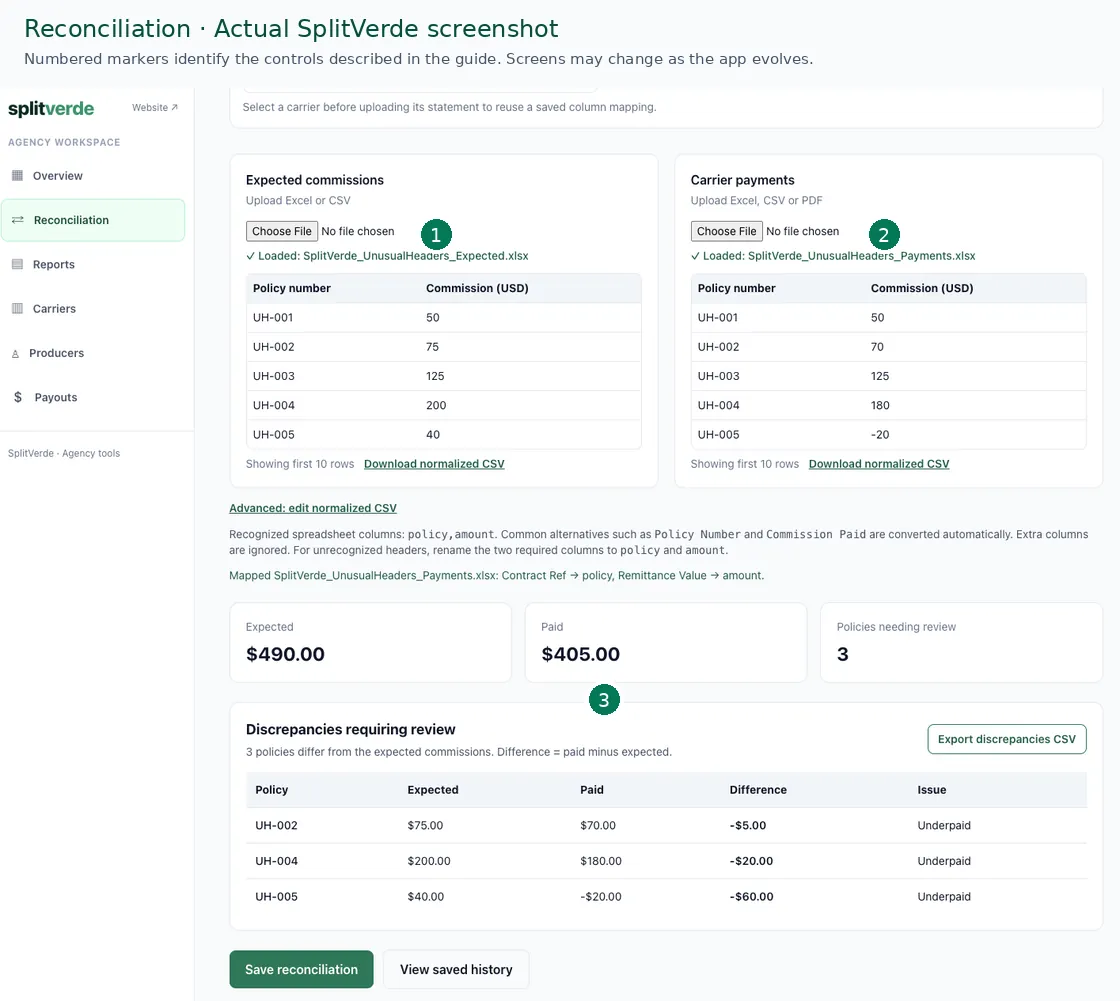
Suppose two policies are expected to pay $200 each. The carrier reports $250 on one and $150 on the other. The overall expected and reported totals are both $400, but there are two policy-level exceptions. A dashboard that shows only net variance would report zero. A better view displays unmatched transaction count, absolute variance, and the underlying policy rows. These fictional amounts illustrate why policy-level matching matters even when the agency's monthly revenue looks correct.
Track aging and ownership
For each open discrepancy, store the first detected date, carrier, policy reference, amount, owner, status, and next follow-up date. An exception aging view helps staff prioritize cases that have been open too long. Separate verified carrier shortages from internal data issues and timing questions. An old case is not automatically a confirmed loss, but it should have an explicit next step. Highlighting unresolved cases without an owner is less useful than showing a smaller list of actionable items.
Keep cash and producer payout views distinct
Carrier statement-to-bank matching checks cash remittances; policy reconciliation checks transaction accuracy. Show both without combining their differences. If producers are paid through the agency, display calculated, approved, and actually paid amounts separately. A payout batch is not proof that money transferred. Apply producer agreements and effective-dated split rules, and review any chargeback deduction under the applicable agreement and law. This separation makes the dashboard more useful to both agency owners and payout reviewers.
Make the dashboard a decision tool
The owner should be able to answer four questions quickly: Which statements are missing? Which confirmed discrepancies are material? Who owns each unresolved case? Which cash or producer payout actions remain pending? Review these questions monthly and remove metrics that do not change decisions. A simple dashboard with reliable source links and clear status definitions is more valuable than a crowded page of attractive but unverifiable numbers.
Extra implementation notes
Consider showing a data freshness indicator beside every carrier. A statement imported yesterday may be current for one carrier and outdated for another. Use the carrier's actual reporting schedule to determine whether a period is complete. If the latest expected statement has not arrived, the dashboard should make that visible before presenting a polished reconciliation percentage. Freshness is a quality control, not a decorative timestamp.
For trend reporting, compare metrics using consistent definitions. A decline in open exception dollars might reflect carrier corrections, revised agency expectations, or excluded transactions. Report those outcomes separately. Verified recovery is not the same as removing an incorrect projection. Likewise, a higher exception count can result from improved detection rather than deteriorating carrier performance. Provide enough context that owners do not punish the process for finding previously hidden problems.
The most useful dashboard also supports investigation. From an exception summary, reviewers should be able to reach the underlying policy reference, statement period, and carrier row. Preserve original source evidence outside any display transformation. If a policy number was normalized for matching, keep the original value available. The dashboard should help users understand the evidence behind a number instead of asking them to trust an unexplained score.
Quick checklist
- Preserve source statements and verify imported row counts and signed totals.
- Distinguish expected commission from carrier-reported and deposited amounts.
- Review exceptions using policy-level evidence and carrier terms.
- Assign unresolved cases to an owner with a follow-up date.
- Retain original entries and link later corrections.
Frequently asked questions
Does a matching deposit mean every policy commission is correct?
No. A matching bank deposit confirms a remittance amount, not the accuracy of individual policy transactions.
Should I delete the original transaction after a carrier correction?
No. Preserve the original and link the later correction for an auditable record.
Can a carrier reversal automatically reduce producer pay?
Not necessarily. Review the signed producer agreement and applicable law before changing compensation.
Related reading
Explore our reconciliation checklist, KPI guide, and producer payouts overview.
The 7-day trial requires a payment card and renews unless canceled. SplitVerde does not offer direct carrier integrations or scanned-image PDF OCR.