Commission operations ·
Insurance Commission Overpayments: How Agencies Should Investigate and Track Refunds
By SplitVerde editorial team · Insurance agency operations
Not every commission discrepancy is money the carrier owes the agency. Sometimes the carrier pays too much, pays twice, or later reverses an earlier credit. These cases need the same discipline as underpayments.
Confirm the payment is truly an overpayment
An unexpectedly large commission can reflect a legitimate endorsement, corrected prior underpayment, supplemental payment, or different compensation rate. Compare the transaction with the policy, carrier agreement, statement code, and prior periods before labeling it an error. A duplicate-looking amount may relate to two distinct transactions. Keep the original carrier evidence and record why the payment appears questionable. Do not assume an overpayment is unrestricted agency income while its status remains unresolved.
Look for duplicate and offsetting entries
Two identical positive rows for one policy may be duplicates, but the carrier may also have reported separate installments or adjustments. Check transaction identifiers, effective dates, and source statement periods. Look for a corresponding negative entry in the same or following cycle. A $150 unexpected credit followed by a $150 reversal may net to zero over time, but both transactions must remain visible. Deleting one entry makes the statement history impossible to reconstruct.
Example: an unexpected extra payment
Suppose the agency expects $250 on a policy but the carrier reports $500 across two identical-looking rows. The potential excess is $250, subject to verifying whether both rows represent the same obligation. If the carrier confirms a duplicate and reverses $250 next month, record the original two credits and later negative adjustment separately. The agency's cash receipts and carrier statement totals should be checked independently. These figures are illustrative and do not imply any particular refund procedure.
Communicate with the carrier using evidence
Send a focused inquiry identifying the policy, statement periods, transaction references, amounts, and suspected duplicate or incorrect rate. Ask whether the carrier intends to reverse the entry on a later statement or requires a separate repayment. Follow the carrier's written instructions and applicable contractual requirements. Do not send money to an unverified payment destination. Keep the response, responsible contact, and next review date attached to the case.
Avoid automatic producer overpayment recovery
If a producer was already paid on an overstated agency commission, the correction may affect producer compensation. But the carrier's reversal does not automatically authorize the agency to deduct wages or commissions. Review the signed producer agreement and applicable law before calculating or executing any recovery. Keep the agency overpayment, potential producer impact, approved adjustment, and actual payout change as separate records. Clear explanations reduce disputes and protect the audit trail.
Reconcile corrections to cash
A carrier may net a reversal against a future remittance instead of requesting a direct refund. In that case, the bank deposit will be smaller even though unrelated policy commissions were paid correctly. Reconcile the carrier's remittance advice to the bank separately from the policy-level error. If the agency issues a refund, retain the authorization and payment confirmation. Never mark the case resolved solely because the current statement total appears lower.
Use a consistent exception lifecycle
Classify the case as suspected overpayment, carrier-confirmed, correction pending, or verified resolved. Assign an owner and review date. Preserve the original positive transaction and any later negative correction. At month-end, report open overpayments separately from missing commission so the agency does not net unrelated issues into a deceptively small variance. This makes financial review more accurate and reduces the risk of surprise clawbacks.
Reserve decisions and communication controls
A suspected overpayment creates a practical cash-management question: can the agency rely on the funds while the carrier investigates? The answer depends on the circumstances, agreements, and accounting advice. Operationally, flag the amount as disputed and make sure the owner or finance reviewer knows about it. Do not silently include the suspected excess in a producer payout calculation without checking the underlying transaction and applicable compensation terms.
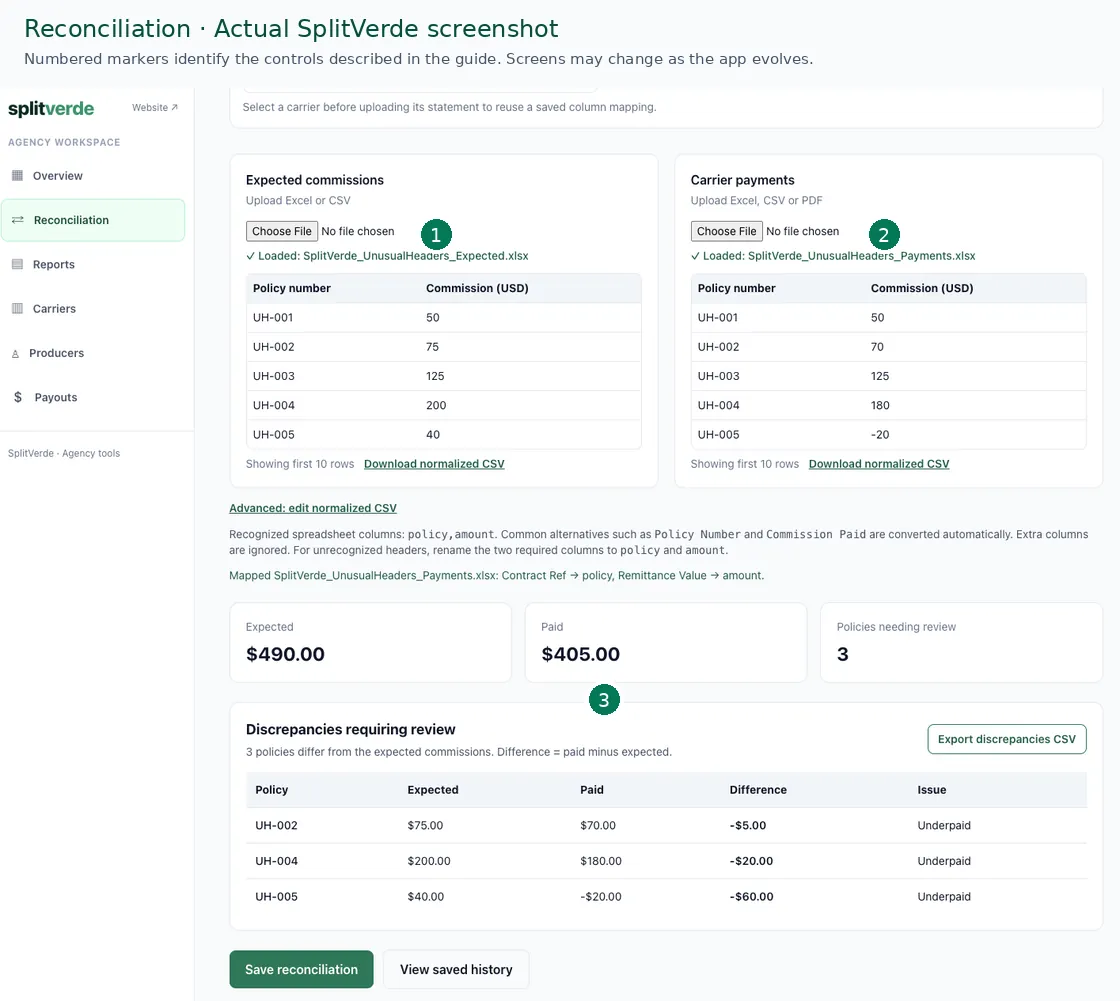
For example, suppose the carrier pays an extra $600 and says it will net the correction against next month's remittance. The next statement may contain $2,400 of valid commissions and a negative $600 adjustment, producing a $1,800 remittance. A bank deposit of $1,800 can be entirely consistent with the carrier's correction, but the agency still needs to verify that the original $600 was actually erroneous. Keep the two statement periods linked so the adjustment is not mistaken for a new policy-level chargeback.
Communication matters when an overpayment involves multiple people. Tell the reconciliation reviewer which case is pending, tell the payout approver whether any related producer share requires review, and retain written carrier instructions. If a direct refund is requested, verify the recipient and payment instructions through trusted channels. Record the actual refund or statement offset only after it occurs. A documented sequence avoids both duplicate repayment and unresolved balances.
Practical checklist
- Keep the original carrier evidence and verify imported row counts and signed totals.
- Record the rule and timing basis for every expected amount.
- Separate policy-level differences from statement-to-bank differences.
- Assign unresolved issues to an owner and set a follow-up date.
- Preserve corrections as new events rather than replacing prior records.
Frequently asked questions
Does a matching bank deposit prove every policy commission is correct?
No. A deposit can match the carrier's remittance even when individual policy transactions contain errors. Reconcile policy-level accuracy separately.
Should an agency delete an incorrect transaction after a correction?
No. Keep the original entry and the correction linked so the timing and explanation remain auditable.
Can a negative carrier commission automatically reduce producer pay?
Not necessarily. Review the producer agreement and applicable law before changing producer compensation.
Related guides
Explore the monthly reconciliation checklist, commission KPIs, and producer splits and payouts.
The 7-day trial requires a payment card and renews unless canceled. SplitVerde does not offer direct carrier integrations or scanned-image PDF OCR.