Commission operations ·
Insurance Agency Commission Month-End Close: Checklist and Example
By SplitVerde editorial team · Insurance agency operations
Month-end close should reveal what is confirmed, what is missing, and what happens next.
Key principle
Preserve carrier evidence, investigate policy-level transactions, and keep projected, reported, approved, and deposited amounts distinct.
Define what counts as a completed month
List the carrier statements expected for the period and record which arrived. Missing statements are incomplete inputs, not proof that every commission is missing. Save original files with clear carrier and period names. Define reviewed, unresolved, and verified statuses before opening the first spreadsheet. A month can be closed operationally even while specific exceptions remain assigned for follow-up.
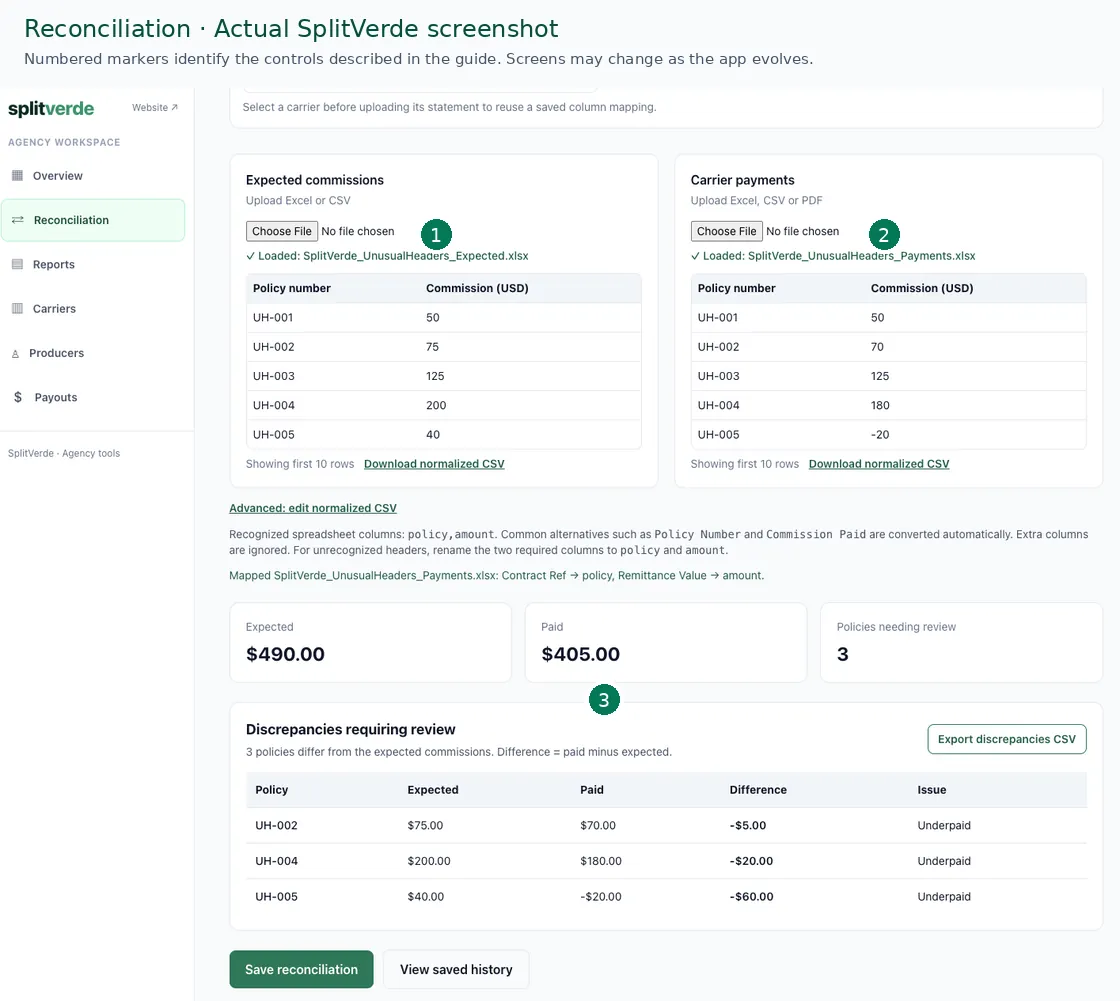
Before acting on a discrepancy, preserve the original carrier statement and verify that the transaction data was imported accurately. Compare the row count and signed total with the source. Check unusual policy identifiers, date formats, and negative adjustments. A CSV that opens successfully can still lose leading zeros; a text-based PDF can still extract columns incorrectly. Keep the source file and the working version so the next reviewer can reconstruct the calculation. If the input is incomplete, label the review incomplete rather than manufacturing a match or shortage.
Validate each carrier statement
Compare imported row counts and signed totals with the source statement. Inspect policy identifiers, negative amounts, dates, and unusual codes. PDF extraction and spreadsheet conversions can create false discrepancies. Correct the import mapping while keeping the source untouched. An accurate reconciliation depends on reliable source transactions.
An expected commission should have a documented basis: policy activity, eligible premium where relevant, transaction type, carrier schedule, and timing conditions. Do not treat every policy effective date as a payment due date. Carrier processing cycles and premium collection may affect eligibility. Record the schedule version and distinguish projected commission, statement-reported commission, and cash deposited. These numbers answer different questions. If the schedule is unclear, mark the expectation uncertain and seek confirmation rather than creating a false late-payment alert.
Reconcile individual policy transactions
Compare expected and reported transactions by policy, carrier, type, period, and amount. Include new business, renewals, endorsements, installments, cancellations, and corrections. Matching totals can hide offsetting policy errors. Preserve individual signed transactions rather than rewriting history. Review ambiguous matches rather than forcing them to agree.
Monthly totals can conceal policy-level mistakes. Suppose two policies are expected to pay $200 each, but the carrier reports $250 for one and $150 for the other. Both totals equal $400 while each policy has a $50 difference. Match using carrier, policy reference, transaction type, statement period, and signed amount. A single policy may have several events over its life, so do not force all transactions into one net row. Review ambiguous matches instead of guessing based only on similar names or amounts.
| Policy | Expected | Carrier reports | Variance |
|---|---|---|---|
| A | $200 | $250 | +$50 |
| B | $200 | $150 | −$50 |
| Total | $400 | $400 | Two exceptions |
Fictional figures. Matching totals do not establish policy-level accuracy.
Assign unresolved exceptions
Maintain an exception queue with policy, source reference, expected amount, reported amount, variance, suspected cause, owner, status, and next review date. Prioritize confirmed shortages. A carrier promise is not a verified correction. Carry open issues into the next month. Document why an agency expectation was revised if that resolves the difference.
Every unresolved exception needs an owner, a source reference, and a follow-up date. Separate confirmed underpayments from timing questions, unexpected positives, chargebacks, and duplicate candidates. When contacting the carrier, provide the policy reference, statement period, expected amount, and rule used for the calculation. Save the response. A representative's promise to fix something next month is not a verified recovery. Leave the case open until a later statement or documented explanation supports closing it.
Review deposits and producer payouts separately
Compare carrier remittances with bank deposits separately from policy-level accuracy. Apply producer agreements and split rates after reviewing carrier transactions. Keep calculated, approved, and paid producer amounts distinct. Review any chargeback deduction against the agreement and applicable law. A payout report is not confirmation that money was transferred.
Producer compensation is a separate layer. The agency's carrier commission is not automatically an individual producer's entitlement. New-business and renewal rates, shared accounts, and agreement effective dates can change the calculation. A negative carrier transaction does not automatically authorize a producer deduction; review the agreement and applicable law. Keep calculated, approved, and actually paid amounts separate. An exported payout report is not proof that money was transferred. This separation prevents reconciliation errors from becoming compensation disputes.
Archive a month-end close package
Save original statements, import checks, match reports, open exceptions, carrier responses, deposit comparisons, and producer approvals. Summarize unresolved amounts and aging. A new employee should be able to reconstruct a selected payment from the records without calling the original reviewer. A good close package preserves both conclusions and the evidence behind them.
At month-end, archive source statements, validation checks, matched and unmatched rows, unresolved cases, and any producer approvals. Compare carrier remittances with bank deposits separately from policy-level accuracy. Link later corrections to the earlier issue instead of rewriting historical statements. Look for recurring problems by carrier; repeated discrepancies may indicate misunderstood schedules or import mapping changes. A repeatable review process should make uncertainty visible and actionable rather than hiding it behind a green dashboard.
Frequently asked questions
Can matching statement totals hide an error?
Yes. Offsetting policy-level differences can hide behind matching totals. Review individual transactions.
Is an expected commission already cash received?
No. Expected amounts, carrier-reported amounts, and bank deposits are separate checkpoints.
Can a carrier chargeback automatically reduce producer pay?
Not necessarily. Review the producer agreement and applicable law before changing compensation.
Related reading
See our reconciliation overview, monthly checklist, and producer payout guide.