Carrier statements ·
Insurance Commission Installment Payments: How to Track Every Carrier Payment
By SplitVerde editorial team · Insurance agency operations
One policy can generate many commission transactions. The challenge is knowing which installments are actually due.
Key principle
Preserve carrier evidence, investigate policy-level transactions, and keep projected, reported, approved, and deposited amounts distinct.
Why one policy can create multiple commission rows
Some carrier arrangements pay commission in installments linked to premium collection or other eligibility conditions. A monthly billed policy may not follow the same payment schedule as a paid-in-full policy. Read the carrier agreement and record the event that makes each installment payable. A single policy can produce several statement rows without indicating duplication or an error.
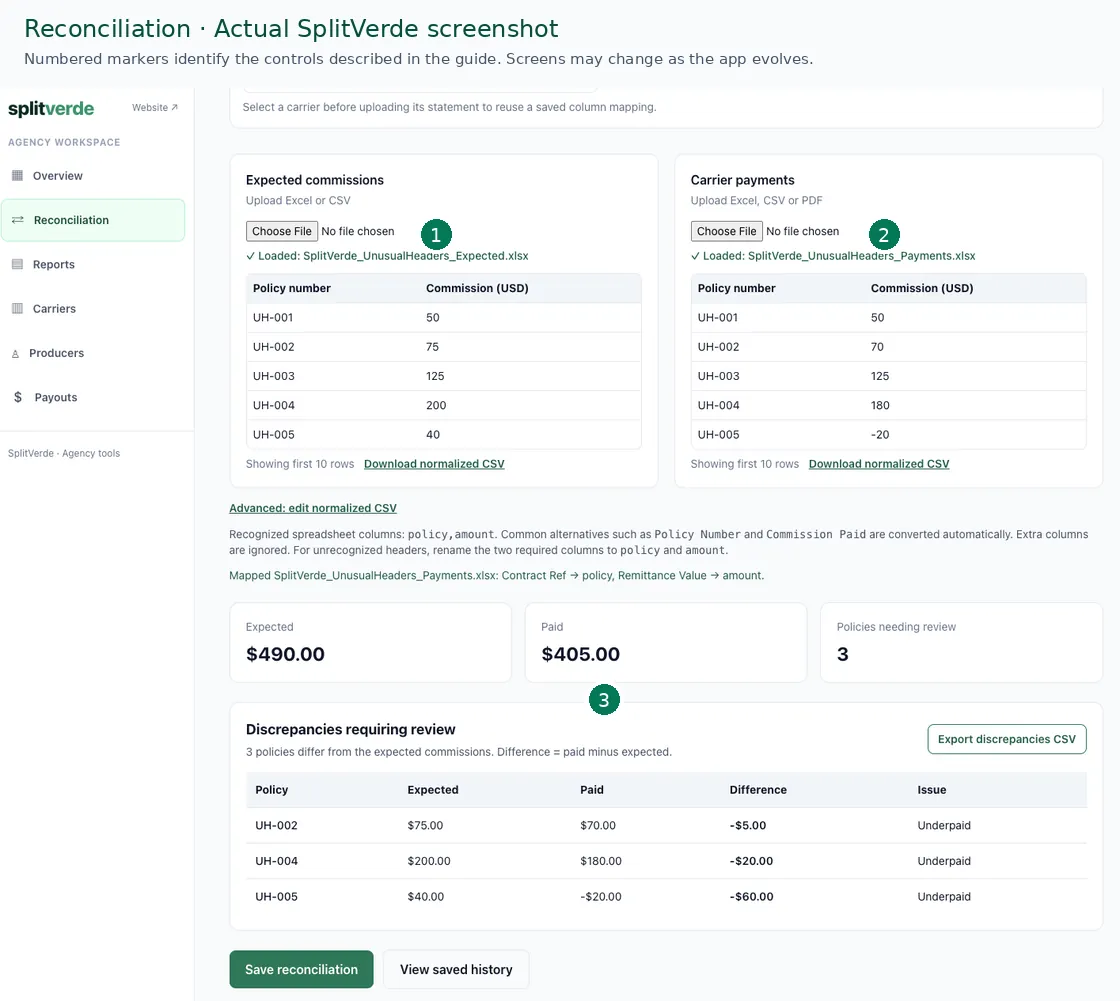
Before acting on a discrepancy, preserve the original carrier statement and verify that the transaction data was imported accurately. Compare the row count and signed total with the source. Check unusual policy identifiers, date formats, and negative adjustments. A CSV that opens successfully can still lose leading zeros; a text-based PDF can still extract columns incorrectly. Keep the source file and the working version so the next reviewer can reconstruct the calculation. If the input is incomplete, label the review incomplete rather than manufacturing a match or shortage.
A twelve-installment example
For illustration, suppose $240 in commission is distributed evenly across twelve eligible installments. Each payment would be $20. After three qualifying cycles, the cumulative expectation would be $60, not $240. If the carrier reports only $40, investigate whether the third installment actually became payable. A skipped premium or processing cutoff may explain the difference. Actual carrier schedules may differ.
An expected commission should have a documented basis: policy activity, eligible premium where relevant, transaction type, carrier schedule, and timing conditions. Do not treat every policy effective date as a payment due date. Carrier processing cycles and premium collection may affect eligibility. Record the schedule version and distinguish projected commission, statement-reported commission, and cash deposited. These numbers answer different questions. If the schedule is unclear, mark the expectation uncertain and seek confirmation rather than creating a false late-payment alert.
Create an installment ledger
Store the policy reference, carrier, installment cycle, premium status if available, expected amount, reported amount, statement period, and exception status. Keep each installment as its own event. When a carrier combines installments into one transaction, document the relationship rather than deleting the detail. The projected full-term total should remain separate from the amount currently eligible for payment.
Monthly totals can conceal policy-level mistakes. Suppose two policies are expected to pay $200 each, but the carrier reports $250 for one and $150 for the other. Both totals equal $400 while each policy has a $50 difference. Match using carrier, policy reference, transaction type, statement period, and signed amount. A single policy may have several events over its life, so do not force all transactions into one net row. Review ambiguous matches instead of guessing based only on similar names or amounts.
| Policy | Expected | Carrier reports | Variance |
|---|---|---|---|
| A | $200 | $250 | +$50 |
| B | $200 | $150 | −$50 |
| Total | $400 | $400 | Two exceptions |
Fictional figures. Matching totals do not establish policy-level accuracy.
Handle cancellations and reinstatements
Cancellation can eliminate future installment expectations and produce negative adjustments for earlier payments. Reinstatement does not guarantee that every skipped installment becomes payable immediately. Keep the original transactions and any later reversals or credits. When a producer is involved, review the agreement before applying a corresponding compensation adjustment.
Every unresolved exception needs an owner, a source reference, and a follow-up date. Separate confirmed underpayments from timing questions, unexpected positives, chargebacks, and duplicate candidates. When contacting the carrier, provide the policy reference, statement period, expected amount, and rule used for the calculation. Save the response. A representative's promise to fix something next month is not a verified recovery. Leave the case open until a later statement or documented explanation supports closing it.
Identify missing installments without false alarms
Look for eligible installments missing from the expected statement, amounts that differ from the documented schedule, unexplained reversals, and carrier rows with no matching installment. Verify the source file first. Then send the carrier the policy reference, installment cycle, expected amount, and eligibility basis. Keep promised corrections open until verified.
Producer compensation is a separate layer. The agency's carrier commission is not automatically an individual producer's entitlement. New-business and renewal rates, shared accounts, and agreement effective dates can change the calculation. A negative carrier transaction does not automatically authorize a producer deduction; review the agreement and applicable law. Keep calculated, approved, and actually paid amounts separate. An exported payout report is not proof that money was transferred. This separation prevents reconciliation errors from becoming compensation disputes.
Report projected, reported, and deposited amounts separately
A useful report distinguishes projected full-term commission, installments currently eligible, carrier-reported amounts, deposits, and unresolved exceptions. Combining these categories can overstate unpaid commission. Carry open installment issues forward with source references and follow-up dates. The goal is to explain each payment without treating every policy as though it pays in one lump sum.
At month-end, archive source statements, validation checks, matched and unmatched rows, unresolved cases, and any producer approvals. Compare carrier remittances with bank deposits separately from policy-level accuracy. Link later corrections to the earlier issue instead of rewriting historical statements. Look for recurring problems by carrier; repeated discrepancies may indicate misunderstood schedules or import mapping changes. A repeatable review process should make uncertainty visible and actionable rather than hiding it behind a green dashboard.
Frequently asked questions
Can matching statement totals hide an error?
Yes. Offsetting policy-level differences can hide behind matching totals. Review individual transactions.
Is an expected commission already cash received?
No. Expected amounts, carrier-reported amounts, and bank deposits are separate checkpoints.
Can a carrier chargeback automatically reduce producer pay?
Not necessarily. Review the producer agreement and applicable law before changing compensation.
Related reading
See our reconciliation overview, monthly checklist, and producer payout guide.