Reconciliation ·
How to Reconcile Insurance Commissions Against Your Book of Business
By SplitVerde editorial team · Insurance agency operations
Carrier statements tell you what the carrier reported. Your book of business helps answer what should have appeared in the first place.
The takeaway
Compare transactions rather than totals, preserve the original carrier evidence, and keep projected, reported, and paid amounts distinct.
Export a reliable policy population
Start with carrier, policy number, effective and expiration dates, transaction status, premium where applicable, producer assignment, and available commission basis. Keep the export date and source. Not every active policy creates a payable commission every month, so use transaction types and schedules to define expectations.
Before making a conclusion, preserve the carrier's original statement and the period it covers. Validate the number of imported transaction rows and the signed commission total against the source. If the file is a PDF, inspect a sample of extracted policy references and amounts; if it is a spreadsheet, check leading zeros and date formats. A clean-looking table can contain bad data. Keep the source file alongside the working results so the next reviewer can trace any discrepancy without reconstructing the download. When the carrier revises a statement, store the revision separately rather than overwriting the earlier evidence.
Preserve policy identifiers as text
Spreadsheet software can strip leading zeros and alter long identifiers. Retain the original policy number alongside any normalized matching key. Use carrier-specific rules and test examples before changing formats. Where identifiers are missing, compare other context but flag uncertain matches for human review.
An expected commission is only as reliable as the assumptions behind it. Record the applicable carrier schedule, transaction type, commission basis, and eligibility conditions. A policy effective date does not automatically establish when commission becomes payable. Premium processing and statement cutoffs may matter. Mark uncertainty openly rather than assigning a confident due date that the contract does not support. Keep projected commissions, statement-reported commissions, and actual bank deposits separate. Those figures answer different questions, and collapsing them into one column creates avoidable confusion when the agency is planning cash flow.
Calculate expected commissions carefully
Apply the relevant compensation schedule and eligible premium basis when appropriate. Some carriers use other structures or conditions. Record the formula and agreement version. Separate projected renewals from commissions currently due. Mark unknown rates or eligibility as incomplete instead of inventing a precise expectation.
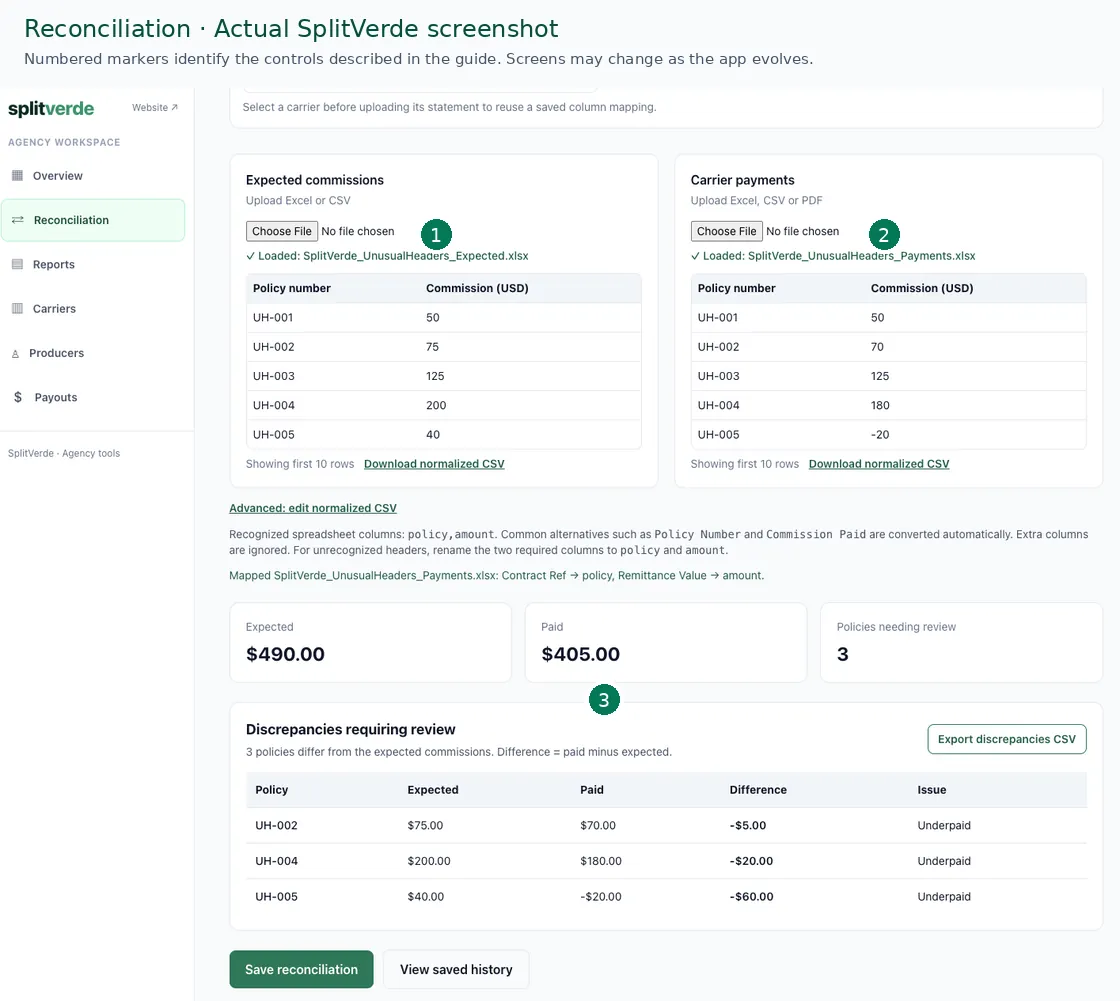
Transaction-level matching matters because totals can hide offsetting errors. Suppose Policy A is expected to pay $200 and Policy B is expected to pay $200. The carrier reports $250 on A and $150 on B. Both totals are $400, but each policy has a $50 discrepancy. Review carrier, policy reference, transaction type, statement period, and signed amount. Do not force an ambiguous match merely because two names or dollar values look similar. If an adjustment arrives later, retain the original transaction and add the new event. This preserves the timeline that makes future questions answerable.
| Policy | Expected | Carrier | Variance |
|---|---|---|---|
| A | $200 | $250 | +$50 |
| B | $200 | $150 | −$50 |
| Total | $400 | $400 | Two exceptions |
Fictional values; investigate policy-level differences rather than netting them away.
Match events, not one row per policy
A policy may have initial commission, installments, endorsements, cancellations, and reinstatements. Preserve separate signed events with their statement periods. A $300 payment followed by a $100 reversal is not the same historical evidence as a single $200 payment, even if the net is identical.
Every unresolved difference needs an owner and a next step. An exception log should include the source row, expected and reported amounts, signed variance, likely reason, status, and follow-up date. Separate confirmed shortages from transactions not yet due, unexpected positive commissions, duplicate candidates, and chargebacks. When contacting a carrier, send a focused inquiry with the policy reference, statement period, and basis for the expected amount. Save the reply. A promise that a correction will appear next month is not a verified resolution. Keep the issue open until a later statement supports closure.
Group the useful exceptions
Review expected-but-absent commissions after their due cycle, amounts that differ from expectations, and carrier rows without matching book records. These may indicate rewrites, transferred accounts, or import problems. Assign each case an owner, supporting evidence, and follow-up date.
Producer compensation should be reviewed as a separate calculation. The agency's carrier commission is not automatically the amount payable to a producer. New-business and renewal rates may differ, and shared accounts may have special arrangements. Record the governing agreement version, commission basis, split rate, calculated share, and approval. A carrier chargeback does not automatically authorize a producer deduction; check the agreement and applicable law. Also distinguish calculated, approved, and actually paid amounts. A payout report is not proof that a bank transfer occurred, even when the arithmetic is correct.
Improve the book from what you learn
Repeated discrepancies may reveal outdated policy status, duplicate accounts, or missing producer assignments in the agency system. Correct the authoritative source with an audit trail. Do not rewrite the book simply to make a carrier statement balance. Reconciliation should improve both payment accuracy and source-data quality.
At month-end, keep a compact record of source statements, import validation, matches, open exceptions, carrier correspondence, and any producer approvals. Compare carrier remittances with bank deposits separately from policy-level matching. Assign unresolved cases to the next review period without rewriting earlier history. Ask whether someone unfamiliar with a transaction could find its source, calculation, and outcome in a few minutes. If not, improve the references. A reliable process is not one that makes every status green; it is one that exposes uncertainty and shows who is responsible for resolving it.
Frequently asked questions
Does a matching monthly total prove every commission is correct?
No. Offsetting policy-level differences can hide behind a matching grand total. Review individual transactions.
Is an expected commission the same as money in the bank?
No. Expected, carrier-reported, and deposited amounts are different checkpoints.
Can a chargeback automatically reduce a producer payout?
Not necessarily. Check the producer agreement and applicable law before changing compensation.
Related guides
Continue with our commission reconciliation guide, monthly checklist, and producer payout walkthrough.