Reconciliation ·
Insurance Agency Book Transfers: Preventing Lost Renewal Commissions
By SplitVerde editorial team · Insurance agency operations
Buying or transferring a book of business can create commission gaps even when the policies remain active. The operational problem is knowing which entity, producer, and carrier code should receive each payment during the transition.
Document the transfer before expecting commission
Start with the purchase or transfer agreement, effective date, included policies, excluded accounts, and compensation provisions. A sale does not guarantee that every carrier will immediately redirect commission. Carrier approval, appointment status, servicing arrangements, and other requirements may affect timing. Confirm these details with the carrier and qualified advisers rather than relying on a spreadsheet's ownership field. Keep the signed transaction documents and carrier confirmations together so the agency can explain why an account belongs in its expected commission population.
Build a policy-level transition inventory
Export the transferred book with carrier, policy number, named insured, renewal date, line of business, prior agency code, receiving agency code, and transfer status. Include the last known commission transaction and its statement period. Preserve original policy identifiers; a carrier may change prefixes or account numbers during conversion. Assign an owner to records that cannot be matched confidently. A transfer inventory should show which policies have been confirmed by the carrier, which remain pending, and which were excluded from the agreement.
Separate pre-transfer and post-transfer entitlements
Consider a policy that renewed shortly before the transfer date but generated a carrier payment afterward. The deposit date alone may not determine which party is entitled to the commission. The purchase agreement and carrier rules may address earned periods, receivables, or transitional servicing. Track the policy's renewal and transaction dates alongside the transfer effective date. Do not automatically treat every post-closing deposit as the buyer's revenue or every pre-closing policy as the seller's. Escalate ambiguous cases for contractual review.
Example: identify a missing renewal
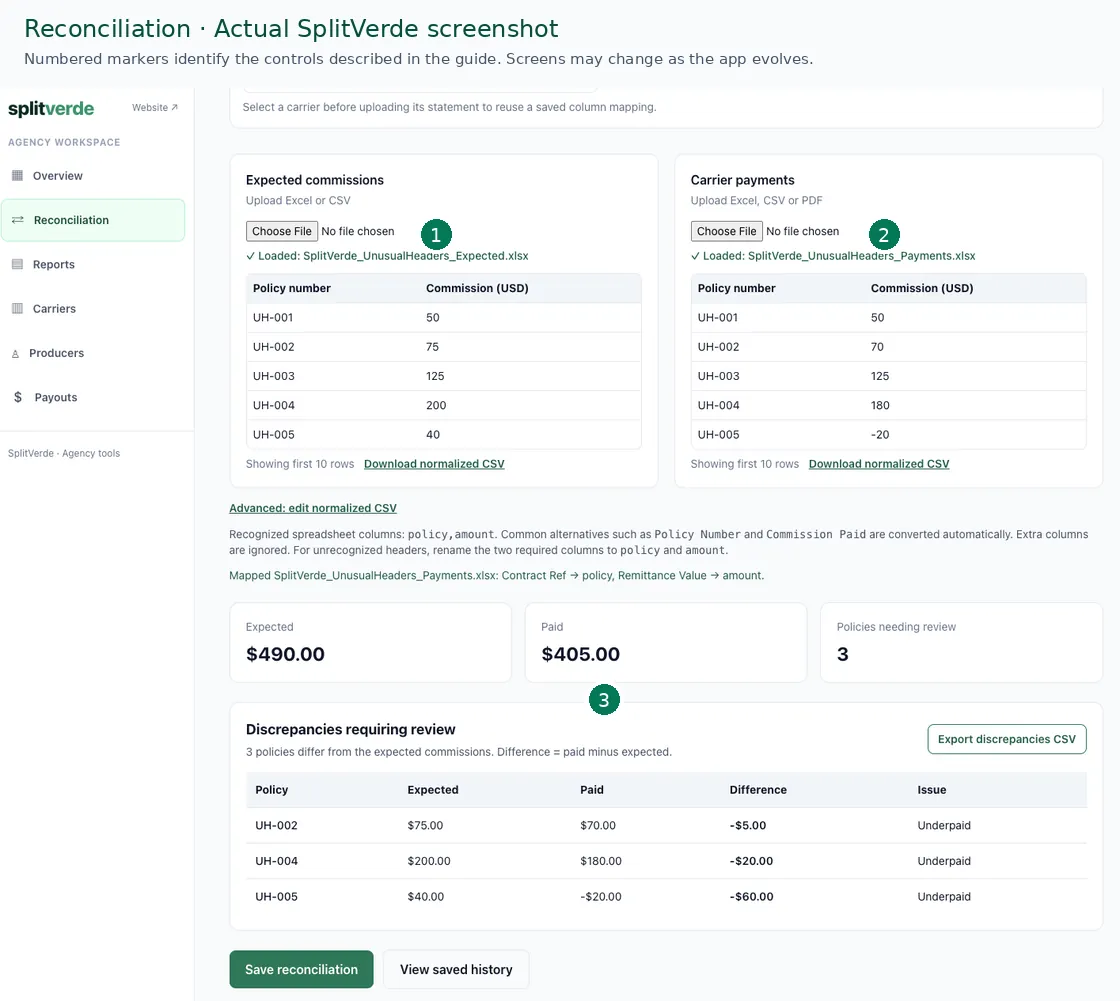
Imagine 300 policies on a transfer schedule, with 80 expected to renew during the first month. The carrier statement includes 76 recognizable renewal transactions. That does not prove four commissions are unpaid: some policies may have canceled, moved, changed identifiers, or not yet become payable. Investigate the four exceptions against carrier confirmation, billing status, and statement timing. This transaction-level approach is more useful than comparing only the total premium transferred with the first month's deposits.
Track agency codes and duplicate remittances
Carrier systems may continue paying a legacy code temporarily or report the same account under a replacement code. Keep a crosswalk of old and new identifiers, including carrier confirmation dates. Check for duplicate payments as well as missing payments. If funds are received by the wrong party, document the remittance and follow the applicable agreement for resolution. Avoid correcting the books by deleting the original carrier row; the original deposit and subsequent transfer or refund should remain traceable.
Account for producer relationships
An acquired book may carry existing producer compensation arrangements, retention agreements, or special splits. Do not assume the acquiring agency's standard split applies to every transferred policy immediately. Record which agreement governs each producer and its effective date. When renewal commission is disputed, keep carrier entitlement, agency ownership, and producer share as separate questions. Communicate calculations using policy references and statement periods, especially during the first few renewal cycles when confusion is most likely.
Close the transition with evidence
Review transferred policies by carrier and renewal month until the expected population is consistently represented. Archive carrier confirmations, identifier crosswalks, exceptions, and resolutions. Compare carrier statements with deposits separately from policy-level accuracy. A transfer is operationally stable when staff can trace the commission from policy and agreement through carrier statement and remittance. Remaining unresolved accounts should have owners and follow-up dates, not disappear into a generic miscellaneous category.
Transition controls for the first ninety days
During the first month after a book transfer, reconcile the policy inventory against carrier confirmations before comparing commission amounts. A policy that has not yet been recognized under the receiving agency code is a transfer exception, not necessarily a payment shortfall. Mark the status clearly and attach the carrier contact or case reference. Where possible, preserve a snapshot of the inventory as of closing, because later policy changes can make the original transfer population hard to reconstruct.
In the second month, compare renewal transactions for the expected cohort with both legacy and new agency codes where authorized data is available. Watch for policies that renewed but were not remitted to the anticipated party. Check for cancellations, rewrites, and identifier changes before assigning a dollar shortage. An account that moved between codes may be paid correctly but difficult to match using a single identifier.
By the third month, review remaining unmatched accounts and recurring carrier processing delays. Produce a short report separating confirmed payment issues, carrier transfer approvals still pending, and contractual allocation questions. That separation helps the buyer, seller, and servicing staff resolve the right problem. The precise review timeline will depend on the book, renewal calendar, and carrier procedures; the ninety-day structure is a practical checkpoint, not a guarantee that all transfers finish within that period.
Practical checklist
- Keep the original carrier evidence and verify imported row counts and signed totals.
- Record the rule and timing basis for every expected amount.
- Separate policy-level differences from statement-to-bank differences.
- Assign unresolved issues to an owner and set a follow-up date.
- Preserve corrections as new events rather than replacing prior records.
Frequently asked questions
Does a matching bank deposit prove every policy commission is correct?
No. A deposit can match the carrier's remittance even when individual policy transactions contain errors. Reconcile policy-level accuracy separately.
Should an agency delete an incorrect transaction after a correction?
No. Keep the original entry and the correction linked so the timing and explanation remain auditable.
Can a negative carrier commission automatically reduce producer pay?
Not necessarily. Review the producer agreement and applicable law before changing producer compensation.
Related guides
Explore the monthly reconciliation checklist, commission KPIs, and producer splits and payouts.
The 7-day trial requires a payment card and renews unless canceled. SplitVerde does not offer direct carrier integrations or scanned-image PDF OCR.