Competitors ·
SplitVerde vs AgencyBloc Commissions+: Pricing, Features, and the Simpler Alternative
By SplitVerde · Comparative editorial · Vendor details checked October 16, 2026
The software market loves to sell you an entire universe when all you asked for was a better way to check your commissions. AgencyBloc Commissions+ is a real option with a real audience. But an independent agent or small agency should not have to pay for a larger operating model unless that model solves a problem they actually have. The useful comparison is not who has the longest feature list. It is which product helps you reconcile carrier statements reliably, investigate the exceptions, and get on with your day.
The short version: AgencyBloc describes a commission platform closely connected to its AMS+ environment, with thousands of carrier maps, audit tools, agent statements, hierarchy structures, and reporting. Those capabilities deserve attention, but they do not make every other approach obsolete. SplitVerde is built around the narrower task of comparing supported carrier statements with expected commission records, flagging discrepancies, and handling producer split calculations in its agency plan. The right choice depends on whether your daily headache is missing commission or a broader operational problem.
What the vendor actually says
Start with the vendor's own material rather than secondhand claims. AgencyBloc says its Commissions+ packages are based on transaction volume and invites prospective buyers to request customized pricing. That is not evidence of a specific monthly cost, so this comparison does not invent one. Review the AgencyBloc Commissions+ product details ↗ and AgencyBloc Commissions+ pricing information ↗ in separate tabs. Features, limits, and promotional offers can change. This article uses publicly described terms checked on October 16, 2026; it is not a substitute for a current contract or written quote.
For context, SplitVerde pricing ↗ lists $5.99 per month for an independent agent and $14.99 per month for an agency. The first plan includes carrier statement imports, discrepancy detection, chargeback tracking, and reconciliation reports; the agency tier adds producer splits, payout reports, and producer statements. Both have a seven-day trial that requires a payment card and converts to a paid subscription unless canceled. The published limits are 1,000 and 5,000 saved reconciliations respectively, with unlimited reconciliation processing.
The real question: do you need a commission tool or an entire operating ecosystem?
The first thing to investigate is scope. AgencyBloc describes a commission platform closely connected to its AMS+ environment, with thousands of carrier maps, audit tools, agent statements, hierarchy structures, and reporting. The wider the feature set, the more important it is to map each capability to a real agency task. Write down which carrier files you receive, how many people review them, and whether you need external system integrations. Then rank those needs before seeing a demo. That protects a small agency from buying an impressive but oversized solution.
Carrier mapping at scale versus a focused monthly reconciliation
A commission problem has several layers: source ingestion, policy matching, exception handling, remittance review, and producer allocation. Agencies already invested in AgencyBloc AMS+—especially health, benefits, and upline organizations—may benefit from connected CRM and commission records. Yet not every agency needs that full architecture. A focused monthly workflow can still be disciplined: preserve original files, validate imported data, investigate variance by policy, and keep unresolved items assigned. Those are the basics worth paying for first.
Where agent hierarchies and branded statements change the calculation
Some buyers need sophisticated compensation operations. Others have one owner and a few producers. That breadth is not always the job a small independent agency is hiring software to do. A team looking primarily to upload statements and inspect variances may prefer a much smaller footprint and a posted monthly price. Think about how often your team changes split agreements, whether producer statements need special hierarchy rules, and who will maintain configuration. Complexity is justified when it replaces real manual effort; otherwise it becomes another job on the monthly close checklist.
What transparent pricing changes for a small agency
Put the total annual spend on paper, not just the first number in a pricing card. AgencyBloc says its Commissions+ packages are based on transaction volume and invites prospective buyers to request customized pricing. That is not evidence of a specific monthly cost, so this comparison does not invent one. Include mandatory setup charges, minimum payee counts, annual prepayment, limits, and the value of any additional services. Do not compare a managed-service plan with a self-service upload tool as though they are identical. The honest comparison is cost for the workflow your agency actually plans to use.
A realistic first-month test before you choose
Run a small pilot with your own statements. A vendor should be evaluated on how it handles your actual policy numbers, dates, negative entries, and carrier-specific columns. Compare results against manually verified transactions, and investigate any mismatch rather than assuming the software is correct. The goal is not to produce the fastest demo. It is to find a process the agency can repeat next month without a spreadsheet archaeology expedition.
When AgencyBloc is the stronger choice
The answer can change as an agency grows. Agencies already invested in AgencyBloc AMS+—especially health, benefits, and upline organizations—may benefit from connected CRM and commission records. If you later need advanced reporting, hierarchies, or native accounting connections, revisit the options with fresh quotes and a concrete requirements list. For now, compare what you need today with what you would be paying today. Software should grow with the work, not create work just to justify its price.
The comparison that matters after the demo
Here is the trap in most software comparisons: a vendor can be better at one task and worse for your budget. Agencies already invested in AgencyBloc AMS+—especially health, benefits, and upline organizations—may benefit from connected CRM and commission records. That is a serious reason to choose it. On the other hand, That breadth is not always the job a small independent agency is hiring software to do. A team looking primarily to upload statements and inspect variances may prefer a much smaller footprint and a posted monthly price. If you only need a monthly reconciliation process, the simplest adequate tool can be the better investment. Nobody gets a commission bonus for buying features they never open.
Price needs context. Customized, transaction-volume-based pricing; no public fixed monthly Commissions+ quote on the reviewed page SplitVerde's own monthly subscription works out to $71.88 a year for the independent plan or $179.88 for the agency plan before any taxes or other charges. Those are straightforward subscription calculations, not promises about savings in staff time. The rival's fees should be evaluated using its stated billing period, required minimums, setup fees, and any negotiated terms.
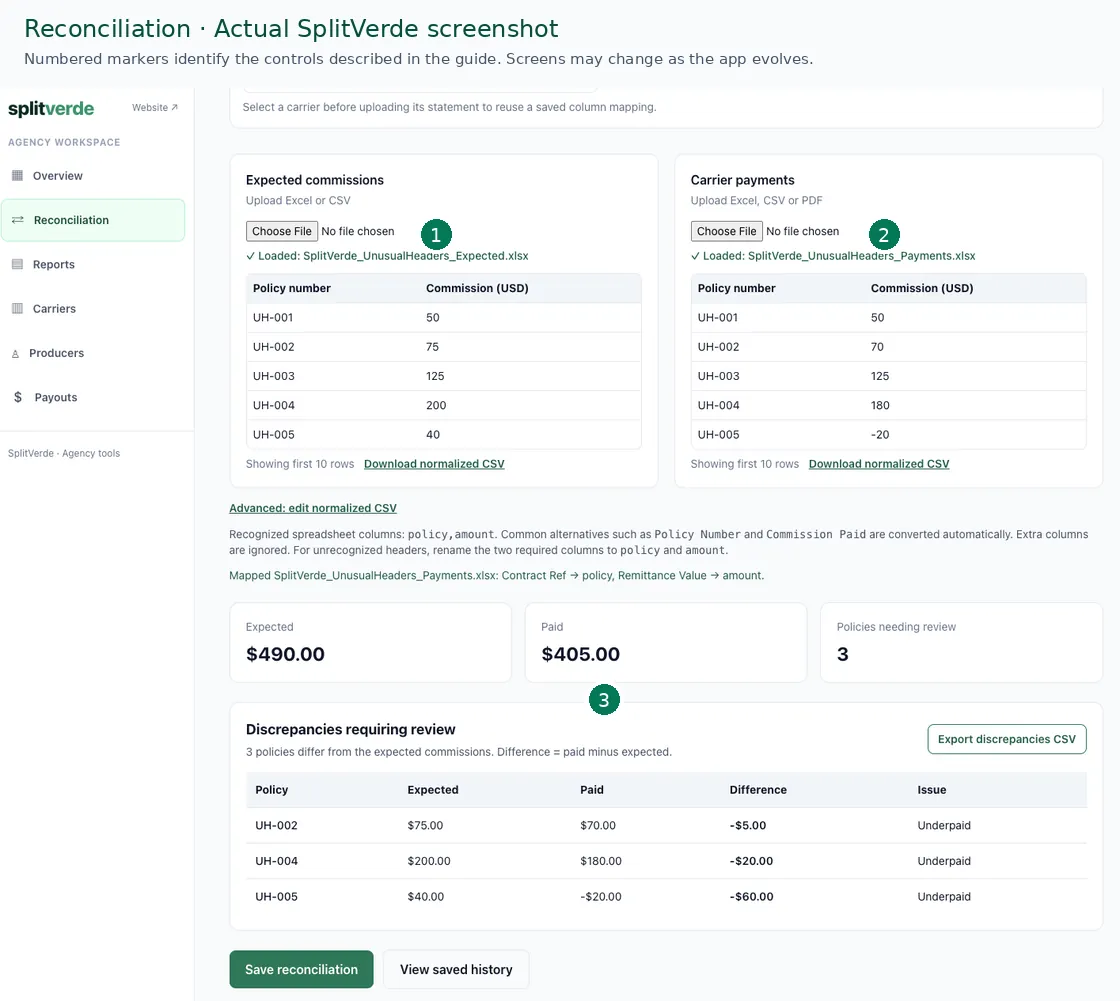
Now imagine an ordinary month. Carrier A sends a spreadsheet, Carrier B sends a readable PDF, and your agency has an expected commission export. The practical job is to preserve the source files, check that row counts and signed totals imported correctly, compare policy-level transactions, and investigate what does not match. If the tool turns that into a manageable routine, it is earning its subscription. If it requires a lengthy configuration project for a simple book, the agency should ask why.
There are also limits worth stating clearly. SplitVerde accepts CSV, Excel, and text-based PDF statements, but it is not a scanned-image OCR service. It does not connect directly to carrier portals, automatically run payroll, or post into an external general ledger. Those gaps matter for some buyers. A credible comparison should name them instead of disguising them as future features. Check the SplitVerde features ↗ and workflow overview ↗ to see what is currently offered.
If your agency has producers, evaluate the entire chain: the carrier payment, the applicable split agreement, the calculated share, the approved payout, and evidence that money was actually transferred. A calculation is not proof of payment. When a carrier issues a chargeback, a negative row does not automatically authorize a producer deduction; the agreement and applicable law govern. A product that gives you a clear audit trail can be more useful than one that merely produces a beautiful net number.
Try a real-world test before switching. Take a statement with one normal renewal, one negative adjustment, one policy-number mismatch, and one known underpayment candidate. Keep the original source. Compare how each product imports the rows, preserves identifiers, explains differences, and lets you follow up. Measure how long the process takes and how confident you feel about the results. Do not assume a vendor's marketing example will resemble your carrier's messiest export.
Also ask what happens when the file is wrong. A spreadsheet can strip leading zeros from policy numbers; a PDF parser can misread columns; a reversal can look like a new missing payment. Verify imported row counts and signed totals before declaring victory. If a platform cannot explain why it matched two transactions, the agency still owns the risk. The most important feature is not automation by itself. It is the ability to trust and check the automation.
So who wins? Not automatically the cheaper product, and not automatically the larger one. AgencyBloc Commissions+ makes sense when its particular strengths solve a genuine requirement. SplitVerde makes a compelling case when the mission is narrower: stop living in spreadsheets, reconcile supported statements, surface exceptions, and keep monthly software costs remarkably low. That is the difference between buying an operating system for the whole business and buying a tool that fixes a specific recurring headache.
At a glance
| Question | SplitVerde | AgencyBloc Commissions+ |
|---|---|---|
| Published pricing | $5.99 solo / $14.99 agency monthly | Customized, transaction-volume-based pricing; no public fixed monthly Commissions+ quote on the reviewed page |
| Primary emphasis | Carrier statement reconciliation and producer splits | AgencyBloc describes a commission platform closely connected to its AMS+ environment, with thousands of carrier maps, audit tools, agent statements, hierarchy structures, and reporting. |
| Best reason to evaluate | Low-cost, focused workflow | Agencies already invested in AgencyBloc AMS+—especially health, benefits, and upline organizations—may benefit from connected CRM and commission records. |
Frequently asked questions
Is SplitVerde always cheaper?
Its posted $5.99 and $14.99 monthly plans are lower than many competitors' paid starting plans, but AgencyBloc Commissions+ may have a different billing structure, a free option, or an unpublished quote. Compare the exact tier and required services rather than assuming every competitor is more expensive.
Does SplitVerde replace every feature in the competitor?
No. AgencyBloc Commissions+ offers a different set of capabilities. SplitVerde focuses on supported statement reconciliation and, on the agency plan, producer splits and payout reporting. It does not claim feature-for-feature parity.
What is the best way to decide?
Try a real carrier statement and compare accuracy, review time, required setup, source transparency, and total subscription cost. Verify all vendor prices and limits before subscribing.
Read the details for yourself
Open the AgencyBloc Commissions+ feature page ↗ and AgencyBloc Commissions+ pricing or product page ↗ alongside SplitVerde's current plans ↗ and SplitVerde's features ↗. Each link opens a new tab so you can compare without losing this guide.
Editorial disclosure: This article is published by SplitVerde, a competing software provider. Vendor descriptions and posted prices were reviewed on October 16, 2026. No competitor endorsement or affiliation is implied.