Producer payouts ·
Insurance Producer Commission Split Calculator: How to Calculate Payouts
By SplitVerde editorial team · Insurance agency operations
A 50/50 split sounds simple until renewals, fees, adjustments, and a negative carrier statement enter the conversation.
The takeaway
Keep the original carrier data, document what you expect, and investigate differences at the transaction level before approving payouts or closing the month.
Define what is being split
Start with the agency's actual commission basis. A split may apply to gross carrier commission, net agency revenue after specified adjustments, or another amount defined in the producer agreement. Do not assume it applies to the customer's premium. Write the basis beside the rate. A correct percentage applied to the wrong number produces a confidently incorrect payout.
Calculate a straightforward split
Suppose the carrier reports $400 in commission on a policy and the producer's agreed share is 40% of that amount. The producer share is $160 and the agency retains $240 before any other permitted adjustments. That is the easy case. Document the carrier transaction, the applicable rate, and the calculation. A simple example is useful because it establishes what a normal result should look like before the exceptions begin.
Separate new business and renewals
Producer agreements often distinguish first-year production from renewal servicing, but the actual terms vary. A 40% new-business split and 25% renewal split would produce different payouts on the same $400 commission: $160 versus $100. Record transaction type and agreement effective date. Do not copy the new-business rate into every renewal row. That mistake can remain invisible for months when totals are reviewed only at the agency level.
| Transaction | Expected | Reported | Next step |
|---|---|---|---|
| Policy A · renewal | $240 | $240 | Matched |
| Policy B · new | $180 | $120 | Check $60 variance |
| Policy C · adjustment | Review | −$75 | Trace original |
Handle shared accounts explicitly
When two producers share credit, decide whether each receives a percentage of the carrier commission or a percentage of a designated producer pool. Those are different formulas. For example, splitting a 40% producer pool evenly means each receives 20% of the carrier commission, not 40%. Store the allocation rule and validate that the shares add up to the intended pool. An unexplained split is a dispute waiting to happen.
Account for negative adjustments carefully
A carrier chargeback may reduce agency commission in a later month. Whether it affects a producer's payout depends on the agreement and relevant rules. Keep the original payment, chargeback, and any producer adjustment as separate records. Never bury a recovery inside a revised historical payout. The ability to explain each movement matters when producers review their statements.
Approve before you pay
Reconcile the carrier statement first, then calculate producer shares, then review exceptions. Verify producer assignments, rate schedules, overrides, and adjustments. Keep an approval record and a separate payment confirmation. A calculated payout is not proof that money was sent. If you export a payout report to payroll or banking software, check the transfer status in that system independently.
Create a repeatable payout worksheet
Useful columns include policy, carrier, transaction type, carrier commission, commission basis, producer, split rate, calculated share, adjustments, approved payout, and payment date. Preserve a link to the original statement row. Even if you move to software later, these fields clarify what the workflow must support. Your agency should be able to reproduce a producer's payout without relying on the memory of whoever built the spreadsheet.
Worked example: splitting a producer pool
Suppose the agency earns $600 in carrier commission and its agreement creates a 50% producer pool. The pool is $300. If Producer A earns 60% of the pool and Producer B earns 40%, their shares are $180 and $120. Neither producer is entitled to 60% or 40% of the full $600 under that example. This distinction is easy to lose when a spreadsheet has a column called simply split percentage. Record both the pool percentage and the producer's share of that pool. Now imagine the carrier posts a $75 adjustment from an older policy. Whether that adjustment changes the current producer pool depends on the agreements and the transaction it relates to. Do not deduct it mechanically from the new policy's commission. Keep the original transaction, adjustment, and any approved producer recovery separate. This gives the agency a clear explanation for every line of a producer statement.
A payout calculator needs more than a percentage
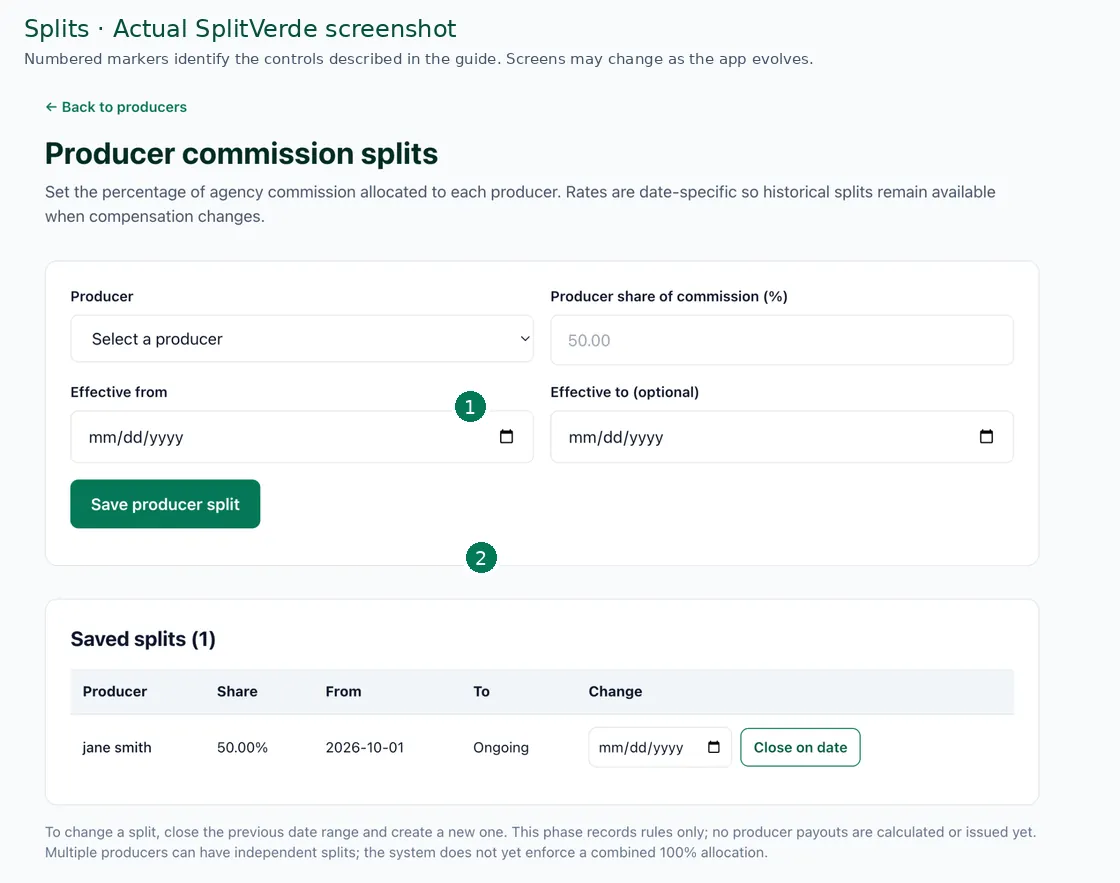
At minimum, capture carrier, policy, transaction type, statement period, commission basis, producer assignment, split rate, agreement effective date, calculated share, approved adjustments, and payment status. New business and renewal percentages may differ. Shared accounts may have multiple producers. Historical rates should not change merely because an administrator updates the current agreement. Before relying on software, manually calculate five known cases: a normal payment, a renewal, a shared policy, a chargeback, and an unassigned policy. Verify that the tool reproduces the known answers and flags ambiguous data rather than guessing. Keep calculation approval separate from actual money movement. A payout report is not evidence that a transfer was completed. SplitVerde can support split and statement workflows, but agencies still need to verify their own contracts and any payment processing outside the calculation.
Frequently asked questions
What is the formula for a producer commission split?
For a percentage-based agreement, multiply the defined commission basis by the agreed split rate, then apply only permitted adjustments.
Do renewal commissions use the same split?
Not necessarily. Check the agreement and transaction type.
Does a payout calculator send money to producers?
No. Calculating a payout and transmitting funds are separate functions unless a product explicitly supports both.
Keep learning
Explore our insurance commission reconciliation guide, statement reconciliation walkthrough, and producer payouts guide.