Commission operations ·
How to Track Insurance Commission Chargebacks Without Losing Money
By SplitVerde editorial team · Insurance agency operations
A negative commission line can turn a perfectly good payday into a mystery. Here is how to trace the reversal without guessing—or charging the wrong producer.
The takeaway
Keep the original carrier data, document what you expect, and investigate differences at the transaction level before approving payouts or closing the month.
Start with the original commission
A chargeback is a negative adjustment to commission that was previously paid or credited. Before entering it as a new expense, locate the original policy transaction and its commission statement. Record the carrier, policy number, effective date, original commission, producer, and statement period. That history tells you what is actually being reversed. A negative line without a source transaction is an investigation item, not a final accounting answer.
Understand why the carrier reversed the payment
Common triggers include cancellation, premium reduction, rescission, nonpayment, and corrections to a prior transaction. Each carrier may use different descriptions and timing. Read the transaction notes and compare them with policy activity. If the amount is unexpected, request the carrier's calculation and the applicable agreement. Do not assume every reversal is wrong, but do not treat an unexplained negative number as self-explanatory either.
Use a transaction-level chargeback register
Keep separate rows for original payment and every adjustment. Record the reversal amount as a signed negative value and link it to the original transaction. Add the statement date, reason, evidence, status, and follow-up owner. Avoid overwriting the original paid amount to make the new net total look tidy. You need the history to explain what happened, especially if a carrier later reinstates the policy or issues another correction.
| Transaction | Expected | Reported | Next step |
|---|---|---|---|
| Policy A · renewal | $240 | $240 | Matched |
| Policy B · new | $180 | $120 | Check $60 variance |
| Policy C · adjustment | Review | −$75 | Trace original |
Reconcile the carrier statement before producer recovery
An agency chargeback and a producer deduction are not automatically the same thing. The agency may receive a negative carrier adjustment, while the producer agreement determines whether, when, and how compensation is recovered. Check the signed agreement and applicable law. Keep the agency-level reconciliation separate from the producer payout calculation. This prevents a carrier correction from silently becoming an unsupported deduction from somebody's paycheck.
Watch for timing and double counting
A carrier might net a reversal against current commissions or post it in a later period. A policy may also have multiple negative adjustments. Match by policy and transaction context, not simply by amount. If the same reversal appears twice, investigate before posting both. If a correction arrives in a later month, link it to the earlier exception so the history remains visible. Monthly totals alone cannot reveal all of these errors.
Build a monthly review routine
Review negative transactions separately, then confirm they are included in the statement total. Check the highest-dollar reversals first, and revisit older unresolved cases. Document the carrier explanation, producer treatment, and final resolution. A short, consistent review is more effective than waiting until the quarter closes and trying to reconstruct what happened from email. Preserve original statement files so adjustments remain auditable.
Decide when software earns its keep
A spreadsheet can work when volume is low and one person owns the process. As transaction counts rise, a reconciliation tool can help surface unexpected negative amounts and unmatched records. Test with real chargebacks, not just clean positive payments. Ask whether you can see the original transaction, the reversal, and the producer calculation separately. The point is fewer mysteries, not a more colorful mystery dashboard.
Example: a cancellation across statement periods
Imagine an agency receives $300 in commission in June. A policy cancels in August and the carrier posts a $180 reversal in September. Preserve the original June payment and record a separate negative September transaction. The net is $120, but neither source statement says $120. If a later correction restores $40, record that as another transaction rather than overwriting history. This matters when the agency is investigating what happened and when a producer questions their compensation. A negative carrier adjustment is not automatically an authorized producer deduction. The applicable agreement and law determine the producer treatment. For every reversal, capture the original transaction, carrier reason, statement period, amount, owner, and follow-up date. Compare negative rows to the source statement before approving any payouts. Two adjustments with the same dollar amount may represent different events, while a duplicated adjustment may appear in separate downloads. Investigate by policy and transaction context, not amount alone.
A month-end chargeback control that works
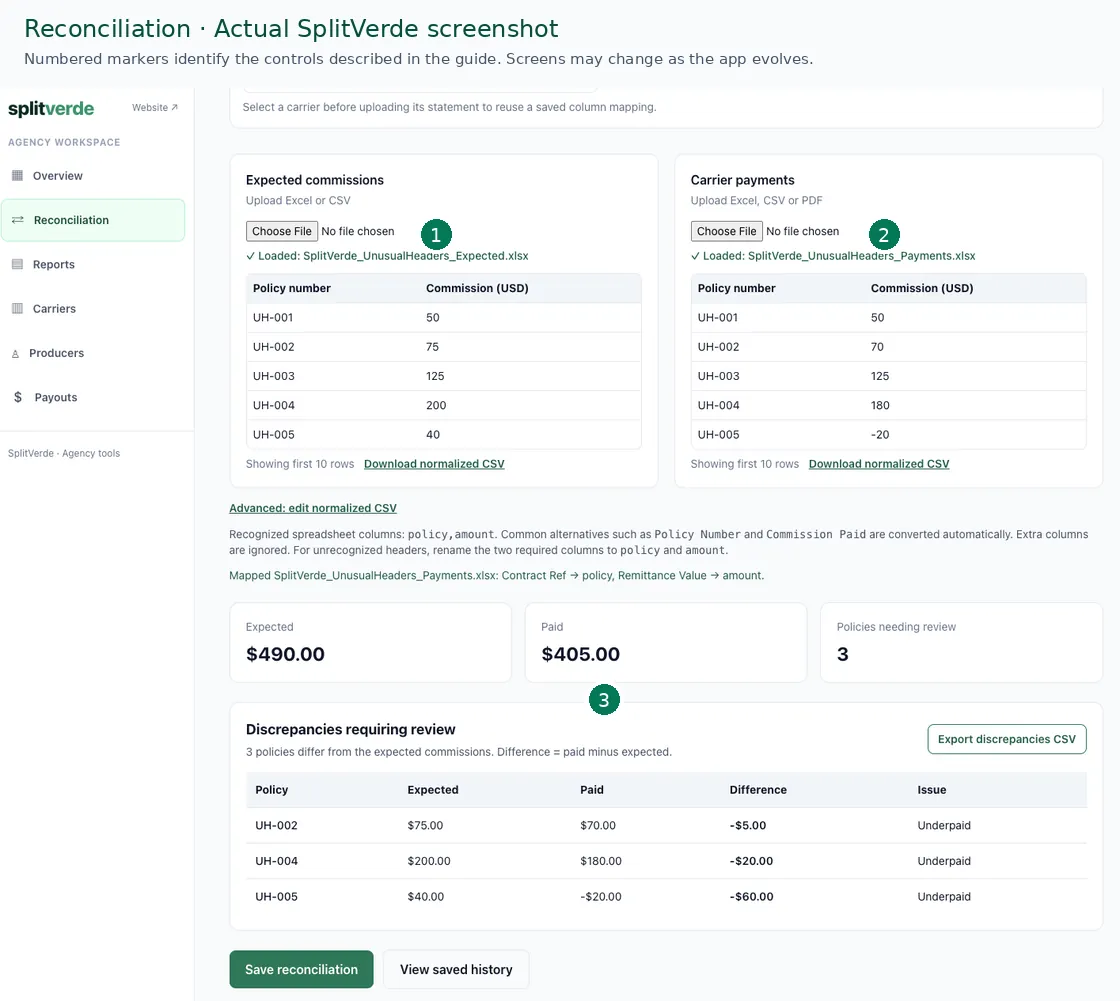
Start by confirming that all carrier statements for the month were downloaded. Compare imported negative row counts and signed totals with each original statement. Investigate the largest reversals and any transactions without an identifiable original commission. Keep open carrier inquiries with a specific next review date. If the carrier nets chargebacks against new commissions, reconcile individual transactions first, then check the statement remittance against the deposit separately. A bank deposit that matches the carrier's net total does not prove that every policy-level adjustment is right. For shared accounts, preserve producer assignments and split agreement versions; do not silently rewrite an older payout. Document who reviewed the negative adjustment and whether it affects any future producer compensation. Finally, archive the carrier file and a copy of unresolved exceptions. This makes the process reproducible if another employee handles the next statement or a producer asks about a deduction months later.
Frequently asked questions
Is a chargeback the same as a refund?
No. A commission chargeback reverses or reduces compensation; the underlying policy refund or premium adjustment may be a separate transaction.
Can an agency deduct every chargeback from a producer?
Not automatically. The producer agreement and applicable law determine whether and how recovery is permitted.
How do I catch duplicate chargebacks?
Compare policy, carrier, transaction reference, amount, and statement period, then verify suspicious repeats against the carrier's source records.
Keep learning
Explore our insurance commission reconciliation guide, statement reconciliation walkthrough, and producer payouts guide.